Monday, October 27, 2025

Sermon for Reformation Sunday: "A Reformation Conversation"

 + Reformation Sunday (observed) – October 26th, 2025 +

Revelation 14:6-7; Romans 3:19-28; John 8:31-36

Beautiful Savior Lutheran Church

Milton, WA

Luther Rose - Brick Books Kit | BannerBlue

 In the Name of the Father and of the + Son and of the Holy Spirit. Amen.

 Today’s sermon is something a little different. It’s an imaginary dialogue between God the Father and one of his baptized sinner/saints. Imagine you picked up the phone and are listening in. And keep these words in mind…

 And to the one who does not work but believes in him who justifies the ungodly, his faith is counted as righteousness - Romans 4:5

 For the first time, I think see it. Your Son died for me and my sin. You took my verdict.

  • I did.
  • So what I can do to show you how grateful I am.
  • You’re not ready for that.
  • Oh, I am. Just tell me what to do. I feel like a runner on the starting blocks. I’m ready to do something really religious!
  • You imagine that I’m impressed by your man-made religious stuff. I’m not. I hate that.
  • You hate religion? But you’re God! I thought you liked religion.
  • I told you. I hate your made up religions. Those are your ideas. Not mine. You’ve forgotten what St. Anselm said: “You have not yet considered the depth of your sin.”
  • But I have. I really have. I know it’s really deep. Teach me sanctification.
  • I told you. You’re not ready for that yet. You just imagine you are. You’re arrogant and you don’t know it.
  • What do you mean? I am 
  • You’re not. If you were, you wouldn’t be talking like that.
  • Well, what then?
  • Just sit there. Sit there for a good long while.
  • And do what?
  • Consider the shed blood of Jesus. Consider that his blood was enough. Think about the fact that it isn’t your anything that has saved you.
  • Can’t I just, as you said, think about my sin and the depth of it?
  • That’s a start. But you like doing that. You like it too much.
  • That makes no sense. What’re you saying?
  • I’m saying that you like atoning for yourself by feeling guilty.
  • What else is there?
  • There’s Jesus Christ – but you don’t consider him. You’re not used to gifts. You don’t think enough about them. Gifts make you nervous. You don’t know what to do, so you jump around trying to impress me. I’m not impressable.
  • I’m confused.
  • You are.
  • Are you saying that I find a thousand ways to avoid your graciousness to me in the cross of Jesus?
  • I am.
  • Are you saying that I try to buy your gifts, try to pay for them so I don’t think about them being gifts? Because I’m afraid that if they are gifts, it’s really too good to be true.
  • That’s what I’m saying.
  • You mean I don’t like letting you freely justify me? I resist what’s really free…justification?
  • You like what’s inside of you. And you shouldn’t. You don’t see that it’s your enemy. Remember, I’m not impressed that way. I love you. I’m your Father. I chose to bring you into the world. And that’s no accident.
  • So… You adopted me, right?
  • That’s right. I adopted you. You delight me. You delight me because of the blood that’s outside you. Because of a verdict based on Me – not on anything inside of you.
  • You mean Christ’s righteousness imputed to me?
  • Yes, that’s what I mean.
  • Well, I’m going to worship you every day.
  • I don’t need your daily worship. I don’t need your daily anything. I am not your mother.
  • Well, do you want me to remember your greatness? Your glory every day?
  • That’s a start. But even pagans recognize my greatness.
  • Well, what then?
  • Remember the inheritance. Think about my generosity to you in the blood of Jesus.
  • But that’s so free. It scares me to think about that.
  • I know. That’s why you want to skip ahead to sanctification so quickly. You like thinking about your gratitude. You like thinking about you. Your obedience might impress your mother, but not me. I want you free.
  • That sounds like some kind of “free lunch” and there’s no free lunch.
  • My Son’s Cross is the only “free lunch” that has ever been.
  • Can I tell you something?
  •  The Lord’s Supper scares me. I go. But it scares me.
  • Why do you think that is?
  • I wonder if I’m ever really ready to come to it.
  • I know.
  • Well, why is that?
  • I told you why. My gifts make you nervous. You like thinking about you.
  • This is driving me crazy!
  • No, it’s not. Right now, I’m driving you sane. The sanity is in seeing the free blood of Jesus – on the cross and in the cup. For you. The insanity is your inclining to your own devotion and obedience.
  • Why is this so hard to understand?
  • Because you’re child of Adam.
  • I know. But I’m not stupid. I have degrees! I’m a child of Adam with a master’s degree!
  • It’s not a matter of intelligence. It’s a matter of sin.
  • So, what’s the answer?
  • I’ve been telling you the answer all along. The answer is the gift. Jesus’ blood. The answer you’re looking for is in someone other than yourself. Your self-religiousness is your enemy. You don’t hate it enough. And you should. I do.
  • You hate my religiousness? You’re kidding, right?
  • The object of your religiousness is you. Not my gifts. Not Jesus’ blood.
  • You mean I worship me?
  • That’s what I mean. You are your own golden calf. You love thinking about your lack of religiosity and you love thinking how full of it you are. Either way, you’re your own favorite idol.
  • Well, maybe I just need more information.
  • You don’t need more information. You’re avoiding me and the free blood by trying to use your intellect.
  • That’s not true. I just want to play my part.
  • You have no part.
  • What does that mean? A salvation without me as a part of it?
  • That’s the only kind of salvation there.
  • Well, I give up. There’s just no cutting a deal with you.
  • Now you’re beginning to see. What you just said is true. I cut the deal with Me along time ago.
  • But this whole thing sounds so cold.
  • It’s as hot as you will ever hear. You just think it’s cold because you can’t impress me. You imagine that if you can’t impress Me, I don’t love you.
  • Well that’s how it is with everyone I’ve met.
  • I’m not “everyone”.
  • This is so good, I feel giddy!
  • I’m not impressed by your giddiness. Now you’re using your excitement to avoid Jesus’ blood.
  • Well, if you’re not impressed by my thoughts or feelings, what does impress you?
  • My Son’s shed blood impresses Me. And his shed blood is yours. Reckoned to you. You drink it every Sunday.
  • So, you’re saying that all of this has to do with You and not me?
  • I didn’t say that.
  • Well, what’re you saying then?
  • You are my beloved child. I made you that. I’m your Father. You do everything you can to avoid the fact that I’m your Father.
  • I don’t want to avoid it.
  • Yes, you do. And I know that.
  • Oh, Father. I’m sorry.
  • You are. And I gave that to you too.
  • You gave me, “I’m sorry.”
  •  Is there anything good or true that I don’t get from your generosity?
  •  But why?
  • Remember the blood. The gift. The free inheritance. You need to think more often about the forgiveness of sins.
  • I do think about that.
  • Yes, but only in a particular way. You wallow in the sin. You imagine forgiveness is based on you somehow. It isn’t. It’s based on Me and on the blood. Your obedience and devotion stink.
  • But not everyone in my church does what I do for You.
  • You’re still trying to impress me with your devotion. I’m not impressed by that. It’s another way of avoiding the blood and the gift. You just want to talk about you 
  • But I thought the church was your creation. What is it then?
  • It’s the place where the same thing I’m telling you is delivered to you. My Word. My Sacraments. The blood. The gifts.
  • But you’re saying it isn’t?
  • Not always. And you chose that church because you “liked it.”
  • Yes, but how else do you choose a church?
  • On the basis of a real Baptism, the imputed righteousness, the Father’s voice in his Word of Law and Gospel, and the blood of Jesus in the Supper.
  • So, you mean that my being your child, inheriting the kingdom, being reconciled to You and made Your friend instead of Your enemy, and all the rest has nothing to do with me?
  •  What do you mean, “almost?”
  • Except for your sin. It was your sin I had to deal with. That had everything to do with you. It required blood and death. And your blood and death wasn’t enough. Only the blood of Jesus and his death can and did deal with your sin, and forgive you.
  • So you mean I had no part?
  • Your sin was your part.
  • But my faith, my devotion, my Christian life are not?
  • All of those stink too.
  • Well, what was redeemable in all of it?
  • You are.
  • But not on the basis of anything about me?
  •  Why did you do it then?
  • Because I loved you before you were.
  • But you’ve said there was nothing in me that was attractive, right?
  •  Well, why then?
  • I told you. I loved you before you even were. Before the foundation of the world. And it cost Me My Son to do it.
  • I can’t take any more of this. But when I recover, can we talk again?
  •  
  • Will you still be like you’ve been just now?
  • I do not change. I was the Father from all eternity. I am the Father now. And I will be the Father tomorrow. The Good Father. Unchanging.
  • Can I count on it?
  • And remember, in the specifics, you can count on the shed blood of Jesus.
  • Thanks.
  • You’re welcome, child.

A blessed Reformation Sunday to each of you…

 In the Name of the Father and of the + Son and of the Holy Spirit. Amen.

A special note of thanks to Dr. Rod Rosenbladt, a dear father in the faith, professor, and friend, from whom this idea originally came and was only slightly modified here. Until we see one another in the resurrection. 


Monday, October 20, 2025

Sermon for Pentecost 19: "God-Breathed"

 + 19th Sunday after Pentecost – October 19th, 2025 +

Series C: Genesis 32:22-30; 2 Timothy 3:14-4:5; Luke 18:1-8

Beautiful Savior Lutheran Church

Milton, WA


Can These Dry Bones Live Again?


In the Name of the Father and of the + Son and of the Holy Spirit. Amen.


In C.S. Lewis’s book, The Magician’s Nephew, the world of Narnia is created when Aslan the great lion appears and sings it into existence. He speaks. His voice. His song. His breath creates Narnia out of nothing. One moment there’s no life. And the next, there’s life. All by Aslan’s breath.


This is a beautiful picture of what God does in the true words of Scripture. All Scripture is God-breathed, Paul writes. Scripture is breathed out by God. Inspired. Inerrant. Infallible. Trustworthy. True. Unfailing. Life-giving. When God breathes out his word he brings us from death to life.


From Genesis to Revelation, when God breathes out, he breathes out life for you in Jesus. His breath and Spirit and Word bring life where there was no life. 


Creation in this world happened this way. God spoke and it happened. “Let there be light…and it was so.” And there was evening and morning the first day. God spoke and it happened. And so it went, day after normal, 24-hour day. Six days of God creating life out of nothing. One moment there was no life. And the next there was life. All by God’s word. His breath creates and sustains and gives life. 


The same is true of Adam’s creation on the 6th day. The Lord God formed the man of dust from the ground and breathed into his nostrils the breath of life, and the man became a living creature.


Sadly, Genesis 2 gave way to Genesis 3. Adam and Eve fell into sin. Sin leaves them physically and spiritually gasping for air. This is what sin did to them and does to us: sin is soul sucking; soul consuming. Like a vacuum that siphons all hope and light and comfort from us. Sin leaves us breathless, gasping for air, unable to breath. Sin brings a spiritual claustrophobia to us. It seals us into the tomb, cuts us off from God’s breath of life. Locks us in prison and says “there’s no life here.” No word. No Spirit. No breath of God. Only the foul air filled with the serpent’s lies and poison…just as he did for Adam and Eve.


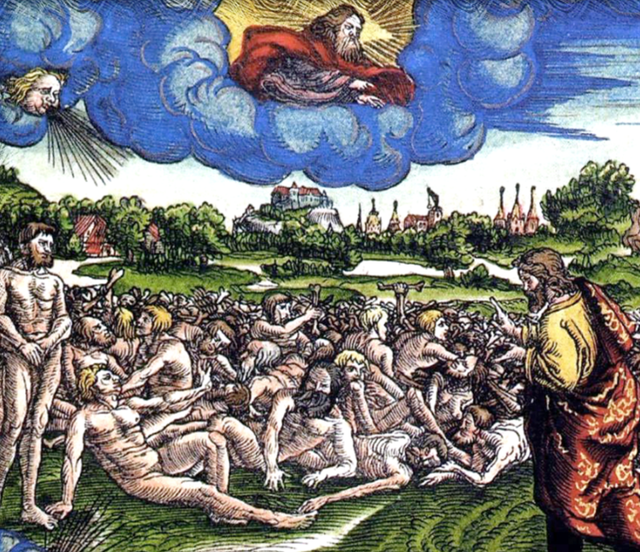
Later in the Scriptures, Israel finds themselves in a similar place. The Lord shows Ezekiel a valley of dry, dead bones. This is the house of Israel. God’s people cut off. Gasping for air. Breathless in their sin. Sealed in the grave and enslaved to their own idolatry.


Jesus’ disciples, also find themselves feeling breathless and winded after Jesus’ resurrection. Having abandoned and denied Jesus. They fled for fear. Hid in fear. And huddled with uneasy breath, locked in an upper room frozen in fear. 


And what does our Lord do? How does he respond to such gasping in our sin? What he always does. He does not leave us breathless or cut off from him in our sin. Instead, He takes our sinful breath away. He swallows all the poison of our sin, Adam’s sin, Israel’s sin, yours and mine, and replaces it with his own life-giving breath. Remember what he did as he hung on the cross. He spoke. He proclaimed. He declared. It is finished. Then he bowed his head and gave up his spirit. He breathed his last…at least for a little while. Three days later, he who gave up his breath on Good Friday breathed the free and gracious air of new life, new creation, and the new dawn of Easter Sunday. 


And then, just as he did in creation, Jesus our Second Adam, the perfect Israel, the Word of God made flesh, spoke. His Word gives life. One moment there’s no life. The next, there’s life. Life out of the grave. A new creation made by Jesus’ cross. 


God kept the promise that he had breathed out and spoken to Adam and Eve long ago. That he would send a Son who would crush the serpent under his foot once and for all. That he would stomp that twisted, forked tongue liar right into the dust of his grave – along with all his lies that fill the air and our ears and hearts and minds.


God kept his promise to Ezekiel and Israel as well. Those dry, dusty, dead bones of Israel became a mighty host. An army of the resurrected. Behold, I will open your graves and raise you from your graves, O my people. And I will bring you into the land of Israel. All by God’s word. God’s breath. God breathing out life from the dead.


So too for his disciples. Jesus came to them in that upper room. In their fears. Their worries. Their pains. Their sin-staggered breathing. And he spoke. He filled that room and their ears and hearts with his life-giving promise, peace, and presence. “Peace be with you. Peace in my hands. Peace in my wounds. Peace in my death and resurrection for you. Breath in. Breath out. Breath the free air of my dying and rising for you.”


So it is for each of us. All Scripture is God-breathed. All Scripture – from Genesis to Revelation - is breathed out by God. Inspired. Trustworthy. True. Unfailing. Life-giving. When God breathes out his word he brings us from death to life. 


When the air around you and your sinful flesh within you leave you feeling as though you are gasping for breath, cut off from God, remember this: the God who created you, formed you in your mother’s womb, and who died and rose from the dead for you, also breathed his life-filled word over the life-giving waters of your baptism. And sent the Lord and giver of life, the Holy Spirit to dwell in you and for you.


On days when your body feels like those dusty, dry, dead bones of Israel. Remember this: the same God who delivered his divinely inspired prophecy to Ezekiel is the one who fulfilled that in his own valley of dry bones on the cross and out of the grave. And he promises that one day, he will speak the same life-giving word and breath out his life-giving breath over our dusty, dead, dry bones. And you will live. You will be resurrected in the flesh. Forever a new creation in body and soul.


When you wrestle with God’s word or struggle to understand parts of Scripture, remember this: the same Lord who inspired the prophets and apostles to write his Word, also sustains you as you read, mark, learn, and inwardly digest his word. His word – all of it – is trustworthy. True. All Scripture is breathed out by God and profitable for teaching, for reproof, for correction, and for training in righteousness, that the man of Godmay be complete, equipped for every good work.


And when you’re feeling like those disciples in the upper room: anxious, afraid, gasping for air, and reeling from your own sin, remember this: the same Lord who came among them and spoke: “Peace be with you” says the same to you today – on the altar, in his body and blood. For your forgiveness. “Peace be with you.” 


In the Name of the Father and of the + Son and of the Holy Spirit. Amen.

Monday, October 13, 2025

Sermon for Pentecost 18: "Together In Christ"

 + 18th Sunday after Pentecost - October 12th, 2025 +

Series C: Series C: Ruth 1:1-19; 2 Timothy 2:1-13; Luke 17:11-19

Beautiful Savior Lutheran Church

Milton, WA


Sermon: “The Healing of the Ten Lepers” – Antiochian Orthodox Archdiocese  of Australia, New Zealand, and the Philippines


In the Name of the Father and of the + Son and of the Holy Spirit. Amen. 


Naomi was far from home. Not Israel. Not Bethlehem. Moab, the ancestral home of Lot’s incestuous relations. To make matters worse, Naomi’s husband, Elimelech, was dead. Her two sons were also dead. No husband. No heir. No home. No inheritance. She had her two daughters in law, but one left. It was just Naomi and Ruth. 


St. Paul found himself alone as well. As he wrote to strengthen and teach young pastor Timothy, Paul was bound in chains. Locked in prison, likely in Rome; and awaiting his eventual martyrdom. 


The same goes for those 10 lepers. They suffered more than an incurable illness. Leprosy was a social disease. A one-way ticket out of town. Lepers were outcasts. Cut off from family, friends. Cut off from the temple, from worship. Whenever someone drew near them on the road, they yelled out, “Unclean! Unclean!” On top of it all, one of those lepers was a Samaritan, a double loner and loser in the eyes of most Israelites. 


Each story, in its own way, begins with loneliness, separation. Naomi and Ruth in Moab. Paul in prison. The lepers outside the village. But they’re not alone. At one point in the past or present, we’ve all been there too. 


Now, I don’t mean the alone time we enjoy with a favorite hobby, or in study, prayer, or devotion, like Jesus often did, and calls us to do. I mean the kind of loneliness we see increasing in our digital age; when the more technology and social media “friends”, “likes”, and heart emojis we have, the more disconnected and alone we feel. 


And yet, our loneliness hits closer to home. It’s personal. Sometimes we’re alienated as a result of our sin, and its consequences in our relationships with family, friends, and neighbors.


Sometimes, it’s the loneliness and pain we experience as one who has been sinned against, one who has been hurt, abused, or wounded in word and deed by others. 


Still, at other times it’s the hurt, despair, and loneliness that affects us for no apparent reason other than the fact that we live in a fallen, broken world, where our body and mind are also plagued with disease. The loneliness of despair and mental illness where you feel entirely isolated and alone even in a crowded room.


But being alone is only part of the story for Naomi, Ruth, Paul, and the Samaritan leper. God did something far greater than they expected or imagined. God met them in their loneliness with his faithfulness, mercy, and compassion.


God led Naomi and Ruth back to the promised land. Back to Bethlehem. Ruth married Boaz. Boaz redeemed the inheritance of Ruth and Naomi, ensuring they would be cared for. Ruth and Boaz also had a son named Obed. Obed fathered Jesse. Jesse fathered David. And David, centuries later, fathered Jesus, the finder of Lost Ones, the Healer of the broken, the Reconciler of Loners. God is faithful to his promise.


St. Paul too, though he was imprisoned, bound in chains, and suffered for the preaching of the Gospel, he was not alone.  This is a faithful saying: For if we died with Him, We shall also live with Him. If we endure, We shall also reign with Him. If we deny Him, He also will deny us.  If we are faithless, He remains faithful; He cannot deny Himself.

Those 10 lepers weren’t alone either. “Jesus, Master, have mercy on us!” They cried out. And he did. He was merciful. Compassionate. Jesus healed them all. 


And one of them, when he saw that he was healed, returned, and with a loud voice glorified God, and fell down on his face at His feet, giving Him thanks. And he was a Samaritan.


The whole event is a marvelous preview of the restoration, renewal, and rebirth that He gives to all in his coming resurrection from the dead. Jesus is the Savior of the nations, Jew, Gentile, Samaritan, everyone. That Samaritan realized that in Jesus, he was no longer alone – not in his leprosy, and not in his sin. He fell down on his face for the same reason people and pastors often bow at parts of the service, in reverence and worship before our Savior. The Samaritan praised him, literally made a doxology to Jesus. 


Naomi, Ruth, St. Paul, and that Samaritan leper were not alone after all. And neither are you. Whatever pain, despair, worry, anxiety, hurt, or sin has left you feeling abandoned, you are not alone. In Jesus, God joined us in our loneliness. For us who are outcast, Jesus became the outcast on the cross. For us who are alone, Jesus cried out, “My God, my God, why have you forsaken me” so that we would never be alone. For us, Jesus endured and bore our pain, suffering, loneliness, worry, doubt, despair, disease, sin, and death so that we would never be abandoned.


Our Lord Jesus promises to be with you, not in the warm fuzzy feelings that come and go. Christ is with you in ways you can touch, taste, see, hear, smell: Jesus’ Word of absolution that releases us from bondage to sin and death. Jesus’ water and word that unites us with our kinsman redeemer; a washing of renewal, regeneration by the Holy Spirit. Jesus is with you in his body and blood hidden in the bread and wine where he promises to be with you, bless, feed, forgive, and restore you. 


Jesus is also with you in your brother and sister in Christ. “When one member of the body of Christ suffers, all suffer. When one member rejoices, all rejoice,” writes St. Paul. We are his children, his family, and he gathers us in his house. 


That’s what this place - this holy house of God - is, and has been for these past 65 years. A safe haven where the outcast, the broken, the lost - the sinner are gathered by Christ. Together in Christ. A harbor of heaven on earth where you are forgiven, healed, and holy in Christ.


For here in our Lord’s house, what God did for Naomi and Ruth, St. Paul, and that Samaritan leper, he does for each of you. In Jesus the lost are found, the lonely are comforted, sinners are redeemed and restored. 


God grant it to this congregation, and you his saints, for another 65 years and until our Lord returns.


In the Name of the Father and of the + Son and of the Holy Spirit. Amen. 


Monday, October 6, 2025

Sermon for Pentecost 17: "How Long?"

 + 17th Sunday after Pentecost – October 5th, 2025 +

Series C: Habakkuk 1:1-4, 2:1-4; 2 Timothy 1:1-14; Luke 17:1-10

Beautiful Savior Lutheran Church

Milton, WA


How Long, Oh Lord? | Pastors' Blog


In the Name of the Father and of the + Son and of the Holy Spirit. Amen.


O Lord, how long shall I cry for help, and you will not hear?

The prophet Habakkuk begins his book with a prayer that echoes throughout the Scriptures. 


It’s not hard to imagine Adam and Eve praying this prayer, wondering when that promised Seed and Son would be born. How long, O Lord?


I’m sure sometime during those 40 days and 40 nights of torrential rains and divine deluge Noah prayed something like this. How long, O Lord?


In his seemingly endless suffering, Job prayed, “How long will you torment me and break me in pieces with words?


In anguish and surrounded by enemies, David prayed, How long, O Lord? Will you forget me forever?     How long will you hide your face from me?


In the midst of Israel love affair with false idols, surrounded by the faithless, Jeremiah lamented, How long will the land mourn and the grass of every field wither? How long?


God’s prophet Habakkuk, faced with the injustice and unrighteousness and wickedness of Judah also carried the tune of this ancient lament before the ears of God. O Lord, how long shall I cry for help,
    and you will not hear?

Habakkuk wrote these words long ago in the 7th century B.C. as Judah as threatened by Babylon without and injustice and evil within. But honestly, he could just as easily have written them today in the 21st century. The wicked seem to prosper. God’s people suffer. Justice is perverted, if there’s any justice at all. The violence and malice of this fallen world seem to win the day along with every headline. Sin and evil and hate seem to be running amuck, like a free-range child let loose on a playground without no supervision in sight. Iniquity appears to go unchecked, unpunished, unhinged. 


And so we pray the prayer that Habakkuk, and so many have prayed before.


How long, O Lord?


It’s a short prayer. But I imagine for most of us, it’s a familiar prayer. How long, O Lord?

When exhausting days turn into sleepless nights. When your calendar is full of more doctors’ appointments than adventures. When you find yourself waiting for a voicemail from the doctor about a diagnosis, or lab work, or what kind of treatment is next. When the only time you see family and friends is at an ever growing list of funerals. You find yourself praying this prayer.


How long, O Lord?

Some think it’s impolite or impious to pray this way. They’re wrong. It’s not. This prayer is a cry for help. For rescue. For God’s righteousness. For things to be made right. For brokeneness to be healed. For wickedness to be thwarted. For grace and mercy to win the day.


Some think it’s a lack of faith that gives rise to prayers like this. It’s not. This is a prayer of faith cried out to the only one who can actually in his time and by his grace answer that prayer. 


So whenever you find yourself praying this prayer, know that you’re in good company. Habakkuk, David, Jeremiah. Prophets. Patriarchs. Even Jesus himself prays something similar in Gethsemane: Father if it be your will, take this cup from me. Nevertheless, not my will but yours be done.


Also know this…when this is the only prayer your weak voice can utter. When it’s prayed in anger or pain. Despair or fear. Whether you’re sobbing or all out of tears. Bring this prayer before God. In fact, he invites it. Why else would he put it in Scripture for us, other than to give voice to our prayers and cries of lament.


When you have a complaint, and we all have them at some point, who better to bring that complaint to than God. Lord, to whom shall we go? You have the words of eternal life, even when all of our words and life are nothing but grumbling and complaining. Complain to God. He can handle it. His grace is sufficient for you, especially when you are weak and it seems as if all is lost. 


Whether it’s this wicked world you lament, or your own sin and folly, or the hurt and pain caused by others. Join Habakkuk in praying, How long, O Lord?


After all, these words do not fall on deaf ears, but on the ears of him who promises to hear. Remember. And answer. 


Habakkuk’s book begins with a complaint to God. But ends with comforted by God. 


Though the fig tree should not blossom,
    nor fruit be on the vines,
the produce of the olive fail
    and the fields yield no food,
the flock be cut off from the fold
    and there be no herd in the stalls,
yet I will rejoice in the Lord;
    I will take joy in the God of my salvation.


Habakkuk rejoiced, even in his suffering, in the one who came to suffer with us. For us. 


Jesus’ “How long?” of Thursday night and Good Friday was answered quickly. 3 days. That’s how long. Cross. Suffering. Death. Burial. Tomb. But then…resurrection. Joy. Life. Light.


We’re not always told how long we’ll pray our “How long?” prayers before they’re answered. But, you can rest assured – with Habakkuk and all who have prayed this prayer before – that God will answer. And when he does answer, it’s always the same answer. Jesus. 


So lay your complaints at the foot of his cross. Cry out your laments; he is full of steadfast love. And know that whenever you pray, “How long, O Lord?”, he will answer. My grace is sufficient for you.


In the Name of the Father and of the + Son and of the Holy Spirit. Amen.