Monday, August 26, 2019

Sermon for Pentecost 11: "The Journey and the Destination"


+ 11th Sunday after Pentecost - August 25, 2019 +
Beautiful Savior Lutheran, Milton
Series C: Isaiah 66:18-23; Hebrews 12:4-29; Luke 13:22-30

Image result for the narrow door

In the Name of the Father and of the + Son and of the Holy Spirit. Amen. 

Long before Pinterest decorations and coffee cups bore these famous words, Ralph Waldo Emerson once wrote, “It’s not the destination; it’s the journey.”

To be sure, there’s wisdom in those words. Enjoying the gifts of God today, and so on.

But Emerson missed something important. The destination matters too.  A family road trip to grandma’s house makes lasting memories because both the journey and the destination matter. Lewis and Clark’s expedition Westward was important because of their journey and their destination. Dorothy’s journey along the yellow brick road through the Land of OZ  is thrilling and adventurous, but in the end, there’s no place like home. 

Both the journey and the destination matter. 

Luke reveals Jesus reenacting the greatest journey of the Old Testament, the Exodus. Remember that at his transfiguration, Jesus, Moses, and Elijah talked about Jesus’ coming exodus to be  accomplished  in Jerusalem. An exodus of freedom from sin and death, liberation from the devil’s tyranny, rescue and redemption in Jesus crucified for you. For Jesus, both the journey and the destination matter.

He went on his way through towns and villages, teaching and journeying toward Jerusalem.

Jesus also gives us a glimpse of the destination along the way; the marriage feast of the Lamb in his kingdom which has no end. His table and feast of forgiveness prepared for us after the greatest enemy of death is defeated.  People will come from east and west, and from north and south, and recline at table in the reign of God. 

And on his  journey to Jerusalem, someone asked Jesus, “Lord, will those who are saved be few?”

It’s a question many have asked. Pondered on a personal level. Debated by theologians and academics. Whatever the motivation, if we get hung up on the question, we’ll miss the main point in this Gospel reading. Notice that Jesus doesn’t really answer the question. The closest he comes is at the end where he says not how manywill be saved but that those who are savedwill come from every language, people, tribe, and nation. And that those saved will be the last, the least, and the lowly - those who have no claim on the kingdom of God, save by grace alone.

Jesus quickly redirects the conversation from examining the “few” out there, to examining the questioner, the disciples, and those gathered around Jesus. 

Strive to enter through the narrow door. For many, I tell you, will seek to enter and will not be able. 

As it goes for Jesus, so it goes for us. In our baptized life of daily repentance and forgiveness of sins, both the journey and the destination matter. Strive, Jesus says, like a wrestler agonizing and struggling with his opponent. 
Strive, Jesus says. For he knows life will not always be easy. Our enemy, the devil, is well-trained, well-equipped and battle-hardened. And he will fight savagely. He is a thief, come to steal, kill, and destroy. He is a liar, come to sow discord, deceit, and despair. He wafts our guilt, shame, and sin in our face like someone holding a dirty diaper to our nose. Through trial and temptation, he hopes to lead us on a very different journey, to an altogether different destination. 

Be vigilant, Jesus warns. Keep our eyes on the journey – to live in God’s gift of daily repentance and forgiveness. And also to keep an eye on the destination. Look for the coming of Christ and his gracious reign. Thy Kingdom Come, we pray. Thy Will be done on earth as it is in heaven. In our Lord’s church. School. Our homes, families, and lives. On the one hand, the journey is done and the victory is ours. And on the other, we strive. Struggle. Wrestle. We live in repentance and forgiveness confessing that this too is the work of God the Father, Son, and Holy Spirit in you and in your life. Jesus calls us here to be who he declared us to be: his holy, baptized, beloved Christians. 

Jesus admonishes us this way, not because we enter the narrow door by our own our own striving and struggling, but because you belong to Jesus who has strived, struggled, and wrestled sin, death, and the devil for you. You are baptized into Jesus who journeyed to the cross to save you. And He invites you to join him this day, and on the Last Day, in a never-ending party, the marriage supper of the Lamb who has conquered death. 

 And people will come from east and west, and from north and south, and recline at table in the kingdom of God.And behold, some are last who will be first, and some are first who will be last.”

This is not what the world, or our sinful flesh expects. When we’re told to strive, we’re told to be stronger, faster, bigger, better. That’s the way of the flesh, but not the cross.

Strive to do nothing, for God has done it all for you. Strive to see that everything we have - our wisdom, strength, gifts, abilities, or possessions - it’s all gift from God. Strive to be last, Jesus says. Least. Nothing. For it is Christ who makes us first. In Jesus, we who are last have become first because He who was first became last for us. Least. Nothing. For us. 

To get to the narrow door, we first pass through the city gates of Jerusalem, where Jesus passes as the true king of Israel.

To sit at the table of Abraham, Isaac, Jacob, and the prophets, we first marvel and believe as  Jesus sits with the disciples at a table prepared with his body and blood to sustains us on the journey.

To enter through the door of life on the last day, we first gaze at Christ who was shut out for us, who was numbered among the transgressors, and who was treated like a sinner, like sin himself, for he bore our sins in his body, and he took them away and died for you. And then the Father raised him from the dead.

This is what sustains us on our pilgrimage, today and every day until we reach our journey’s end.

 For you have not come to what may be touched, a blazing fire and darkness and gloom and a tempestand the sound of a trumpet and a voice whose words made the hearers beg that no further messages be spoken to them...But you have come to Mount Zion and to the city of the living God, the heavenly Jerusalem, and to innumerable angels in festal gathering,and to the assembly of the firstborn who are enrolled in heaven, and to God, the judge of all, and to the spirits of the righteous made perfect, and to Jesus, the mediator of a new covenant, and to the sprinkled blood that speaks a better word than the blood of Abel.

In the Name of the Father and of the + Son and of the Holy Spirit. Amen. 

Friday, August 23, 2019

Sermon for Pentecost 10: "Through the Fire"


+ 10thSunday after Pentecost – August 18th, 2019 +
Beautiful Savior Lutheran, Milton
Series C: Jeremiah 23:16-29; Hebrews 11:17-12:3; Luke 12:49-53

In the Name of the Father and of the + Son and of the Holy Spirit. Amen.


“I came to cast fire on the earth, and would that it were already kindled! I have a baptism to be baptized with, and how great is my distress until it is accomplished! Do you think that I have come to give peace on earth? No, I tell you, but rather division. For from now on in one house there will be five divided, three against two and two against three. They will be divided, father against son and son against father, mother against daughter and daughter against mother, mother-in-law against her daughter-in-law and daughter-in-law against mother-in-law.”

I’m guessing none of us have this section of Scripture for our confirmation verse or scrolled in beautiful calligraphy over our fire place. Perhaps you even winced a little after the Gospel reading when we confessed, “This is the Gospel of the Lord.”

There’s no doubt about it. Jesus’ words in Luke 12 are challenging to hear. Hard to understand. Why is the Prince of Peace speaking about fire, baptism, peace, and division? 

We can better understand Jesus’ pyrotechnic preaching by looking at the context and content of Jesus’ words. Knowing what’s happening in Luke 12 and what Jesus says will give us a better grasp of this hard saying of Jesus, and help us better understand what Jesus is saying to us today in these words.

First, some context. Throughout Luke 12, Jesus addresses several groups of people: His disciples. The crowds who follow him. And the Pharisees. Jesus prepares his disciples for future persecutions; he warns the disciples and the crowds against the hypocrisy of the Pharisees; and he lovingly admonishes them not to trust in possessions. Fear not. Jesus’ death and resurrection is greater than all that life throws at you. God has you covered. He is faithful. He will preserve, protect, and deliver you. 

And then comes today’s reading: I came to cast fire on the earth, and would that it were already kindled! I have a baptism to be baptized with, and how great is my distress until it is accomplished!  

Even though his language sounds jarring to our ears at first, Jesus’ words have been leading us and his disciples to this very point. Fire. Baptism. Peace. Division. These words encompass everything Jesus’ ministry is about. 

Fire, as we know well during wildfire season, is both destructive and purifying. Scripture uses fire both ways: as a sign of God’s judgment and wrath against sin, like we hear from the fiery preacher of repentance, John the Baptist. Fire is also refining, purifying, holy-making like when Jesus pours out the Holy Spirit and fire on Pentecost, the fiery wind of the Spirit. Gospel fire. Like the pillar of fire that led Israel through the Sea or the fire of the burning bush that did not burn up, the fire Jesus casts upon the earth is a refining, purifying, illuminating fire that saves.

For Jesus is the one upon whom the fire of God’s wrath for sin will fall. On the cross, God’s wrath is kindled, not against us, but Jesus. We’re like Shadrach, Meshach, and Abednego, as Jesus is crucified in the fiery furnace of God’s wrath to save us. Jesus passes through the fire so that we will not be burned. 

For that fire to be kindled, there must be sacrifice, a whole burnt offering, a sinless Victim for the sinful many. For this peace that passes our understanding to come to us, there must be a death, and not just any death, but the death of God in the Flesh. He alone can kindle this fire. No amount of rubbing the sticks of our good works together can accomplish this, no matter how many merit badges we accumulate to our credit. Only Jesus can bring Pentecost fire to the earth, but first, He must die and rise. There is no other way than the way of the cross. And in the words of today’s Gospel, He is driven and compelled to go this lonely mission. His eyes are fixed to the cross like a cyclist zeroed in on the last leg of the Tour de France.

And would that it were already kindled, Jesus says. Great is my distress until it is accomplished. Finished. Completed. 

When Jesus speaks of fire and baptism, he’s pointing his disciples and us ahead to his crucifixion for us. It’s no accident that his ministry begins and ends with Baptism. First his watery baptism in the Jordan as he placed himself under God’s wrath as our substitute. Then his bloody baptism on the cross as he atones for the sin of the world. The water of the Jordan that flowed over Jesus’ head gives way to the water and blood that flows out of Jesus’ side. From the cross. To the font. To the chalice. To you. For you.  

Jesus’ baptism set him on the road to Calvary. It was the washing of the Sacrifice. “Behold, the Lamb of God who takes away the sin of the world.” And Jesus was compelled to see His baptism through to the end and its fulfillment when He could cry out, “It is finished.”

This is what brings peace. In the darkness of Good Friday, the fire of God’s love burns brightest. The burning passion of God to save sinful humanity and a fallen creation. There, in Jesus’ death, is a peace that the world cannot give, a peace the world does not know, a peace the world hates. It’s the peace of sins washed away by the blood of the Lamb, the peace of God in Christ reconciling the world to Himself, not counting men’s sins against them, the peace of God’s justifying Word that declares us righteous for Jesus’ sake alone, the peace of a quiet conscience knowing that there is no condemnation for those who are in Christ Jesus.

This, then, is the irony and paradox of the Christian life. Living in this peace. Baptized into Jesus’ death and resurrection. Purified and cleansed by his sacrifice on the cross means that more often than not, we find ourselves at odds with the world. 
Do you think that I have come to give peace on earth? No, I tell you, but rather division. 

I’m sure for many of us, Jesus’ words hit home. We live in a divided world. Simply confessing the Christian faith, and living in Christ, we’re divided from those who don’t. Some leave the church or reject our Lord. And then there’s our sins of thought, word, and deed that cause division in our families, marriages, friendships, and everything. It’s a sober reminder that we don’t find the family of God in ancestry.com, but in the cross; in the font; and at the altar – in the communion of saints.

Jesus himself was no stranger to division. For that’s exactly what happened to him on the cross. The Father against the Son. Forsaken for you. Judged for you. Crucified for you. Jesus was divided from the Father as he bore all our sins of division, so that in his death and resurrection we would never be divided from him. 

Therefore let us run with endurance the race that is set before us, looking to Jesus, the founder and perfecter of our faith, who for the joy that was set before him endured the cross, despising the shame, and is seated at the right hand of the throne of God. Consider him who endured from sinners such hostility against himself, so that you may not grow weary or fainthearted.

In the Name of the Father and of the + Son and of the Holy Spirit. Amen. 

Monday, August 12, 2019

Funeral Sermon for Ellen Ehinger: "Dependable"


+ In Memoriam - Elle Ehinger +
Beautiful Savior Lutheran, Milton
Graveside at Sumner Cemetery
1 Corinthians 15

Image result for jesus' resurrection full of eyes

In the Name of + Jesus. Amen.

Life in this fallen world has a peculiar way of being dependably undependable. The trusty family car breaks  down. The old faithful freezer gives out. The once strong company suffers mass layoffs. Sooner or later, we find ourselves sighing, “They sure don’t make ‘em like they used to.”  Even our own bodies, once healthy and active, get sick, grow old, and die. 

We often find ourselves singing or praying the words of the old hymn: 

Swift to its close ebbs out life's little day;
Earth's joys grow dim; its glories pass away;
Change and decay in all around I see;
O Thou who changest not, abide with me. 

I imagine that in the 98 years of life God gave to Ellen, she saw her fair share of disappointments, struggles, and suffering too. But Ellen also knew that even though life in this fallen world is full of undependable things and people,  the love of God in Christ Jesus is far greater and more certain than all the uncertainties of life. 

She knew and heard Jesus’ Word of truth and life which was a lamp to her feet and a light to her path. She knew that Jesus is the same yesterday, today, and tomorrow for her and for you. She knew that the love of God in Christ crucified and risen is the one thing that is truly and perfectly and unfailingly dependable. She knew that she was baptized into the most dependable, trustworthy, and reliable person there is - Jesus in his death and resurrection for her and for you.

Several months ago, during one of our visits, we were reading the Scriptures before receiving Holy Communion. And though I don’t remember which passage I was reading, I do remember something remarkable Ellen said about the passage we had just read: “Jesus’ resurrection,” she declared, “that...you can depend on.”

You see, Ellen believed and confessed that in this topsy-turvy world, Jesus crucified and risen is our constant. Our north star in the night. Our anchor in the maelstrom. Our compass in our earthly pilgrimage. Reminds me of an old saying from the Carthusian monks of the 11th Century: Stat Crux Dum Volvitur Orbis. The Cross stays steady while the world turns.

“Jesus’ resurrection. That...you can depend on.”

In those brief but beautiful words, Ellen confessed what St. Paul declares in 1 Corinthians 15:

For if Christ has not been raised, your faith is futile and you are still in your sins. Then those also who have fallen asleep in Christ have perished. If in Christ we have hopein this life only, we are of all people most to be pitied.
But in fact Christ has been raised from the dead, the firstfruits of those who have fallen asleep. For as by a man came death, by a man has come also the resurrection of the dead. For as in Adam all die, so also in Christ shall all be made alive.
St. Paul reminds us that Ellen’s life - and our lives as God’s baptized, beloved children - is a life lived in God’s gracious, merciful, loving dependability towards us. Though we are faithless, Jesus is faithful. Though our life twists and turns, and is full of ups and downs, the love of Jesus crucified and risen is changeless and unchanging. Even today, in the middle of a cemetery, in our grief and tears, Jesus is and always shall be the dependable one for us. 

In Jesus’ death and resurrection, the Last Enemy of Death has been defeated, for Ellen and for you.

In Jesus’ death and resurrection, we receive a true and trustworthy hope of the resurrection of our own bodies and life everlasting. A physical, real resurrection for Ellen and for you. A joyful reunion with those we love who have died in the faith. But we also receive strength, mercy, and every good thing in life today because of Jesus’ death and resurrection.

In Jesus’ death and resurrection, we have received Him who is truly, eternally, and daily dependable for you, just as he was for Ellen throughout her life.

Behold! I tell you a mystery. We shall not all sleep, but we shall all be changed, in a moment, in the twinkling of an eye, at the last trumpet. For the trumpet will sound, and the dead will be raised imperishable, and we shall be changed. For this perishable body must put on the imperishable, and this mortal body must put on immortality. When the perishable puts on the imperishable, and the mortal puts on immortality, then shall come to pass the saying that is written:
“Death is swallowed up in victory.”
“O death, where is your victory?
    O death, where is your sting?”
The sting of death is sin, and the power of sin is the law. But thanks be to God, who gives us the victory through our Lord Jesus Christ.

Jesus’ resurrection and Ellen’s and yours. That...you can depend on.


In the Name of + Jesus. Amen. 


Sermon for Pentecost 9: "Theology and Ornithology"


+ 9thSunday after Pentecost – August 11, 2019 +
Beautiful Savior Lutheran, Milton
Series C: Genesis 15:1-6; Hebrews 11:1-16; Luke 12:22-34

Image result for consider the birds of the air

In the Name of the Father and of the + Son and of the Holy Spirit. Amen. 

Picture yourself in Catechism class, bible study, or Sunday School. Your coffee or tea in one hand. Your bible in the other. You’re waiting for the bell to ring. And then, instead of the pastor or teacher walking to the front of the room, a raven swoops in. 

That’s what Jesus is doing for us Luke 12. He’s giving us a little Christian theology and ornithology. Today Jesus wants us to learn from the birds. 

To know, trust, and believe that we need not worry about our daily life. God has you covered in Jesus. He who did not spare his own Son but gave him up for us all, how will he not also with him graciously give us all things?

To know, trust, and believe that if our Lord cares for birds in such abundance, not only does He give us the greatest gift of eternal life, but every day gifts we need for Sunday or a Tuesday.

To know, trust, and believe that if our Lord clothes the flowers of the field with a greater and more glorious wardrobe than Solomon, he clothes us, not only with his righteousness in Christ, but also clothing, shoes, and all good things. 

So today, Jesus invites us to consider the birds.

Consider the birds he created and blessed on the 5thday of creation to be fruitful and multiply: to soar and sing his praises. Consider the ravens and doves he gave to Noah to scout the dry lands of the new creation after the flood. Consider the ravens he sent with food to sustain Elijah in his despair. 

Consider the ravens: they neither sow nor reap, they have neither storehouse nor barn, and yet God feeds them. Of how much more value are you than the birds! 

I love how Martin Luther illustrates this in one of his sermons. “I take my hat off to you, my dear teacher, I have to admit I don’t have the art you have. You sleep all night in your little nest without a care in the world. In the morning you leave; you’re happy and bright. You sit on a limb of a tree and sing, praise, and give thanks to God, then you fly off looking for a little kernel of grain and find it. Why haven’t I, old fool that I am, learned to do the same?”

Luther’s right. The birds put us to shame. We worry. Fret. Doubt. Despair. We have sleepless nights, churning stomachs, headaches, heart palpitations, stress, and the list goes on. 

This kind of inward focused worry and anxiety is like a cancer of the soul, consuming us from the inside, paralyzing us, disordering our lives, our eating, our drinking, our priorities. It eats away at us like rust, corroding our souls until we are nothing but a shell. 

Jesus knew His disciples’ hearts just as He knows our own. He knew that He had called them away from their fishing boats and tax collectors office. And there were probably days when they wondered aloud, “What are we going to eat today? How will we afford clothing when ours wears out?” They were following someone who had no place to lay His head, who didn’t promise them wealth and prosperity like the prosperity preachers you hear today. Jesus never promised them any of that. Instead He promised them hardship and persecutions in this life and eternal life in a kingdom that has no end. 
Consider the ravens, Jesus says to His anxious disciples. Look at the birds. They neither sow nor reap nor store in barns, and yet God feeds them.Yes, they spend the bulk of their day looking for food. And yes, they work their feathered tails off building nests. But in the end, they are completely dependent on their environment. “And yet God feeds them.”The hidden hand of God cares even for the birds of the air. And if He cares about the birds, how much more he cares for you. You are worth so much more than the birds.
You are worth so much to our Lord, valued so greatly and loved so deeply by him that he became - not a bird; not a flower – but man for you. Jesus became an infant, without a care in the world, born to carry our burdens, worries, and cares upon himself. Jesus came to die on a tree for you, to gather you in his arms as a hen gathers her chicks. Jesus sends the same Holy Spirit that descended upon him in the form of a dove to dwell with you. Today. Tomorrow. Forever. 
Jesus feeds us as he does the birds of the air, only better. Grain that becomes bread that is his body. Fruit that ferments and becomes wine that is his blood. Given. Shed. For you. For your forgiveness, life, and salvation – not just eternally, but presently too. Reminds me of a popular Christian symbol from the 12thcentury: a mother pelican who was thought to be attentive, to the point of piercing her own breast to feed her young when food was scarce. It’s a symbol that points us to Jesus who was pierced for us and feeds us with his body and blood in the Lord’s Supper. His kingdom which comes to you in his word, water, body and blood.
Seek his kingdom, and these things will be added to you. 
“Fear not, little flock, for it is your Father's good pleasure to give you the kingdom.
That’s the good news Jesus speaks to our anxieties and fears today. It is our Father’s good pleasure to give us the kingdom, and He works everything together for you to receive the kingdom. You have it all, thanks to Jesus. His death and life has purchased what you cannot afford. Life with God. You have His Word on it. He clothes you in Baptism; He feeds you in His Supper. You have the kingdom. And because he’s given you the big stuff, you can rest assured that he’ll care for you in the small stuff too. 
In the Name of the Father and of the + Son and of the Holy Spirit. Amen.

Monday, July 15, 2019

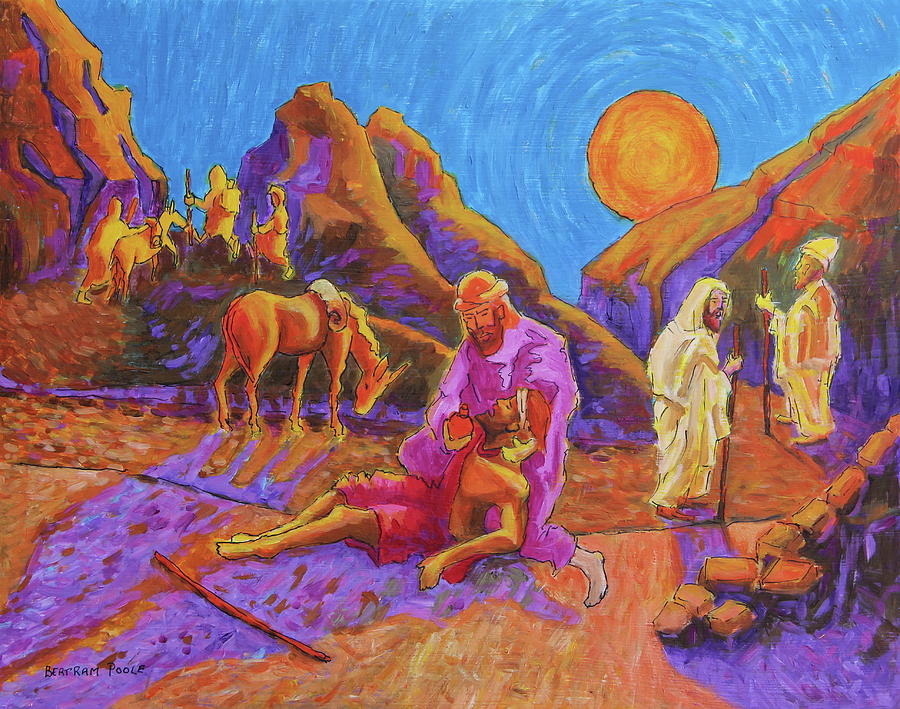
Sermon for Pentecost 5: "Jesus, the Good Samaritan"


+ 5thSunday after Pentecost – July 14th, 2019 +
Series C: Leviticus 18:1-5, 9-18; Colossians 1:1-14; Luke 10:25-37
Beautiful Savior Lutheran, Milton

Image result for jesus the good samaritan

In the Name of the Father and of the + Son and of the Holy Spirit. Amen. 
“All the world’s a stage, And all the men and women merely players.” 

Although Shakespeare’s famous words were written about the parts we play in various stages of human life, his words give us a helpful way to see Jesus’ parables. Jesus’ parables are a stage for God’s unexpected mercy, and Jesus’ shocking, outrageous undeserved, unmerited, and unconditional love for the lost, least, last, losers and outcast. Think of Jesus’ parables as a divine drama, where his compassion, mercy, and love are center stage.

This doesn’t mean the parables cease to be God’s Word. Quite the opposite. Jesus’ parables are God’s Word through and through. His Word taught and proclaimed and given to us with all the richness and imagination of the storyteller, the divine playwright himself, Jesus the Word of God made flesh. 

It’s no surprise, then, that we find Jesus’ parables full of the dramatic: villains and heroes. Lead actors and supporting roles. Plot and story arc. Truth, meaning, and symbolism. And so on. 

Now, usually when we read the Parable of the Good Samaritan we imagine ourselves playing the lead role of the Samaritan. “The moral of the story is…Don’t be like the priest. Don’t be like the Levite. Be like the Samaritan. Be nice. Do good. Treat others the way you want to be treated. Pay it forward.”

And while it’s true, Jesus calls us to love our neighbor, we miss the whole point of this story if begin by putting ourselves in the spotlight of this parable. For as soon as we do, it’s not too long before we start to feel the heat and bright lights hitting us like sun glares on the freeway. Revealing, exposing, and shedding the spotlight us.
How would Siskel and Ebert, or a Broadway review rate our performance as Good Samaritans? How are we doing at keeping Jesus’ commands?  Are you loving the Lord your God with allyour heart, and allyour soul, and allyour strength, and allyour mind? How about your neighbor? Are you loving your neighbor as much as you love yourself? 
Go down that road long enough and it’s not too long before we find ourselves just like that certain man in the story: beaten, bloody, and left for dead in the ditch. 
Remember how this all started. The whole story of the Good Samaritan begins with a question about salvation. A lawyer asked Jesus, “Teacher, what shall I do to inherit eternal life?”
The answer to this man’s question is found, not by focusing the spotlight on us and our work, but Jesus crucified and his work for us. Not in seeing ourselves as good Samaritans, but to see Jesus as the Good and Perfect Samaritan who comes and finds us lost, and outcast, and left for dead on the side of the road.
If the point of this story is to be the Good Samaritan. Inherit eternal life. Love the Lord your God with everything you are and have and love your neighbor as yourself, then we’re all as good as dead. We flop and fail time and time again. We may as well be lying in the ditch beaten and bloodied and on the road to the grave. 
And that’s exactly where Jesus wants us. That’s the point Jesus is making here. If anyone is like the Samaritan, it’s not us, it’s Jesus. Jesus is the Good Samaritan who rescues us, pulls us out of the ditch. Binds our wounds in his. Carries us with him to the cross. Everything we need is charged to his account. 
Only Jesus is the Good Samaritan. Jesus loves the Lord his God with all his heart, all his soul, all his strength, all his mind. Jesus loves the neighbor as himself, even those who hated and rejected him. 
Jesus became that Good Samaritan who bent down in compassion to rescue us. Jesus loved His neighbor and He loved God. He fulfilled the Law with His love. 

As Isaiah declares, he was pierced for our transgressions;    he was crushed for our iniquities;
upon him was the chastisement that brought us peace,
    and with his wounds we are healed.

In His love for us, for all of humanity, for His whole creation, Jesus joined us in the ditch. Jesus became the man who fell among thieves, crucified between two of them, bloodied and beaten by a world who did not want Him or His way of salvation. Left for dead on the cross, crucified and risen for you. What the Law demands – and what we have not done – Jesus does and gives for you. Jesus helps us who can never help ourselves. He washes away our blood with his own healing blood. He strips himself and wraps us in own garments of righteous love. 
As St. Paul proclaims: He has delivered us from the domain of darkness and transferred us to the kingdom of his beloved Son, in whom we have redemption, the forgiveness of sins.
The story of the Good Samaritan is the story of Jesus’ compassion towards us. It is the story of his self-giving, self-denying love for us. It’s also the story of our love for others. 
Which of these three, do you think, proved to be a neighbor to the man who fell among the robbers?” He said, “The one who showed him mercy.” And Jesus said to him, “You go, and do likewise.”

Someone once said that telling people the Good News of Jesus crucified for them is like one beggar telling another beggar where to find bread. 
Our life of love, compassion, and good works for our neighbor works the same way. Each one of us are fellow dead-beat sinner-saints rescued from the ditch, called to share Jesus’ mercy and compassion with those who are in the ditch with us. We love because he first loved us. This is what we do – we go to our neighbors in the ditch, because that is what God has done for us in Jesus.
In the Name of the Father and of the + Son and of the Holy Spirit. Amen. 

Wednesday, July 10, 2019

Sermon for Pentecost 4: "Sent"


+ 4thSunday after Pentecost – July 7, 2019 +
Series C: Isaiah 66:10-14; Galatians 6:1-10, 14-18; Luke 10:1-20
Beautiful Savior Lutheran, Milton


In the Name of the Father and of the + Son and of the Holy Spirit. Amen. 

God is the God who sends.

In the Old Testament, the Lord sent the prophet Isaiah to declare judgment of Israel’s sins and words of comfort in the midst of Jerusalem’s destruction. As one whom his mother comforts,  so I will comfort you;  you shall be comforted in Jerusalem.

After his death, resurrection, and ascension, the Lord sent the apostle Paul to proclaim to the Galatians that we are justified, not by works of the Law, but by faith in Christ Crucified, freely as a gift, and to teach them how justified Christians live: So then, as we have opportunity, let us do good to everyone, and especially to those who are of the household of faith.

Before his death and resurrection, the Lord sent out disciples. First the 12 disciples in Luke 9; and here in Luke 10, the 72 disciples. Jesus gave the 72 the same words he gave Isaiah, Paul, the prophets, and apostles to declare: a word of warning and promise. To declare “Peace to this house for the reign and rule, the kingdom of God has come near to you.”

God is the God who sends. The Father sent his only begotten Son, Jesus. Jesus sent his disciples as apostles, “sent ones”. The harvest is plentiful, but the laborers are few. Therefore pray earnestly that the Lord of the harvest would send out laborers into his harvest. 

Normally in scripture the harvest is an image of judgment. But not here. Here the harvest is an image of Jesus’ mission to seek and save the lost. So, Jesus sent out the 72. 

Jesus sent them with his authority. Jesus taught them His Words. Jesus promised they would be receive provision along the way. The one thing Jesus did not give the 72 was an easy job. 

Behold, I am sending you out as lambs in the midst of wolves. 

The 72 were sent to represent the Lamb of God who takes away the sin of the world, the One who was going to His sacrificial death on the cross. 

God is the God who sends. So did not send the 72 out alone. As God sent the animals into the ark 2 by 2 to make a new creation, Jesus sends the word of his new creation out two by two. Safety in numbers from the wolves. But also a communion and fellowship in Jesus. 

Jesus does the same for us too.. Calls us his children. Welcomes us into the Father’s house. Feeds us his own body and blood. Gathers us together so that we’re not easy pickings for the wolves. Our Lord doesn’t call us to be solitary Christians, but to live together in fellowship and communion around his gifts. And to invite others to hear that Good News of Jesus Crucified and receive his gifts.

God is the God who sends. And that’s the message Jesus sent the 72 to proclaim. Heal the sick and say to them, ‘The Kingdom of God has come near to you.’ Whatever house you enter, first say, ‘Peace be to this house.’

Not the kind of peace get from a Hallmark card, or watching a beautiful sunset, or between warring nations. But peace in sins forgiven. Peace in the kingdom of God – God’s good and gracious rule and reign – that has come in Christ. Peace in Jesus crucified and risen.

Jesus also prepared those 72 sent ones for what would happen as they were sent out. Some would hear and rejoice. Some would hear and reject. 

Whenever you enter a town and they receive you, eat what is set before you. Heal the sick in it and say to them, ‘The kingdom of God has come near to you.’ But whenever you enter a town and they do not receive you, go into its streets and say, ‘Even the dust of your town that clings to our feet we wipe off against you. Nevertheless know this, that the kingdom of God has come near.’ I tell you, it will be more bearable on that day for Sodom than for that town.

That’s the thing about a gift. It’s given. And sadly, it can be rejected. To refuse the gifts is to reject the Giver. To refuse salvation is to reject the Savior. That’s what makes the “unforgivable sin” unforgivable - the refusal to be forgiven. The kingdom of God has drawn near, but you want nothing to do with it. The forgiveness of sins is there for you, but you see nothing in yourself that needs forgiveness. 

This is why Jesus sent out the 12. And then the 72. And then the Holy Spirit at Pentecost. And then more apostles and disciples. And finally his church. To proclaim the Good News that God is the God who sends. 

For God loved the world in this way that he gave his only Son, that whoever believes in him should not perish but have eternal life. For God did not send his Son into the world to condemn the world, but in order that the world might be saved through him.

Though we are not the 12 or the 72, though we are not prophets or apostles, though we are not given the unique promises to tread on scorpions or snakes or heal the sick, God is still the God who sends. 

The Holy Spirit who was poured out at Pentecost is sent to dwell with you as you as a baptized child of God. The Father who sent his only-begotten Son to save you welcomes you to his house in this place to receive true and lasting peace in His Son. Peace of sins forgiven. Peace in Jesus’ body and blood. Peace that no matter how bad the world gets, no matter how fowl the wolves breath and fierce his fangs, no matter how bad our sin, how deep our guilt, how painful our hurt – His Son was sent to take it all upon himself on the cross for you.

And the same Son, Jesus, who was with the 72, is with you. Today when you heard these words, “I forgive you all your sin” you hear Jesus’ absolution. Today as receive Jesus’ body and blood you receive a holy, medicine of immortality. Today as you hear the Word of Jesus and receive his peace in his holy Supper, the kingdom of God has come near to you.

And though we’re not the 12 or the 72, we are each called to different vocations to love and serve our neighbor. Sent out by the God who sent Jesus to save us.


In the Name of the Father and of the + Son and of the Holy Spirit. Amen.

Monday, July 1, 2019

Sermon for Pentecost 3: "On the Road Again"


+ 3rdSunday after Pentecost – June 30, 2019 +
Series C: 1 Kigns 19:9-21; Galatians 5:1, 13-25; Luke 9:51-62
Beautiful Savior Lutheran, Milton
Image result for jesus set his face toward jerusalem


In the Name of the Father and of the + Son and of the Holy Spirit. Amen. 

Family road trips are full of questions. Right after the famous…“Are we there yet?”…comes the next question. “Where are we going?” I imagine the disciples often asked these questions too. But just in case there was any doubt or confusion, Luke tells us over and over again in his Gospel where Jesus was going and why. 
When the days drew near for him to be taken up, he set his face to go to Jerusalem.
This was Jesus’ purpose. That’s why Jesus was born of the Virgin Mary. Why He obeyed and fulfilled the Law. Why He was baptized in the Jordan. Jesus came to be “taken up” on the cross for you in order to take us up together with Him. And so He set His face to Jerusalem. For you.
On his way, Jesus traveled through Samaria. And the Samaritans refused Him. Why? Because His face was set toward Jerusalem. Samaritans worshipped on Mt. Gerazim – in the old Northern Kingdom from the Old Testament, not Jerusalem in the south. The Samaritans in Luke 9 did not understand why Jesus set his face towards Jerusalem. Ironically, neither did his own disciples.
James and John, the “sons of thunder,” wanted to call down a little Sodom and Gomorrah style airstrike. “Lord, do you want us to tell fire to come down from heaven and consume them?”
But that’s not the message Jesus called them to proclaim to all nations. Didn’t they get it? Didn’t they see who Jesus was? It’s easy to point the finger at the disciples and forget that we’re no different. 
James and John admit the truth about all of us. It’s not for us, just as it wasn’t for James and John, to call down fire from heaven to consume those who aren’t nice to us. The same fire and brimstone we call down on others, could very well be called down upon us. No, this kind of judgment, thankfully, hasn’t been given to us…can you just imagine what kind of chaos we’d cause if we did have that power?
What’s truly remarkable is that God doesn’t judge us as we would judge others. The Lord is slow to anger and abounding in steadfast love. Jesus sets his face towards Jerusalem. God judges the world by sending Jesus to be judged in our place. God desires to seek and to save the lost, even Samaritans, even you and me. And he goes to the greatest length possible, even death on a cross, to be judged in our place, to rescue us from sin and death forever. For all the times we’ve set our face in the opposite direction of our heavenly Father, Jesus set his face to Jerusalem for you. And for all.
Jesus set His face to Jerusalem also for the Samaritans, even those who turned Him away and slammed the door in His face. You can walk down the streets, any street at any time of any day, and look in the face of any random person, be they rich or poor, young or old, well-dressed or not, and you can truthfully say to yourself, “Jesus gave His life on the cross to save that person.” He set His face to the cross of Jerusalem to save this person. There would be no fire from heaven for the Samaritans or for you, only for Jesus. That’s the way of the cross. And the way of the cross is also the way for you his disciples.
As they were going along the road, someone said to him, “I will follow you wherever you go.”  And Jesus said to him, “Foxes have holes, and birds of the air have nests, but the Son of Man has nowhere to lay his head.”  To another he said, “Follow me.” But he said, “Lord, let me first go and bury my father.” And Jesussaid to him, “Leave the dead to bury their own dead. But as for you, go and proclaim the kingdom of God.”  Yet another said, “I will follow you, Lord, but let me first say farewell to those at my home.” Jesus said to him, “No one who puts his hand to the plow and looks back is fit for the kingdom of God.”
Tough words aren’t they? Jesus’ claim on his disciples is radical. It’s all or nothing. No halfway, half-hearted disciples. To follow Jesus is to go the way of Jerusalem with him; to the cross. To follow Jesus is to die and rise with Jesus. To lose your life in order to save it. To become least in order to receive greatness. 
That’s what Jesus saw when He set His face to Jerusalem. Yes, he saw the cross, He saw his suffering. His death. But above all, he saw you. His focus was like that of a lifeguard venturing out into the rip currents with only one thing in mind. Saving you. 
And so, the disciple’s focus is on Jesus, the author and perfecter of our faith. We don’t look to ourselves. For the moment we do, we get it all wrong. Rather, look to Jesus Crucified for you.
Remember Elijah. When he looked to himself and started whining about how he was the only faithful one left in all of Israel and how everyone was trying to kill him, that’s when he got it wrong. He had his little pity party at Mt. Horeb. Queen Jezebel had issued death threats against him. And he expected God to flex some muscle…you know, call down some fire. He thought he was the only faithful Israelite left on the face of the earth. We call it an “Elijah complex” today, when we think we’re the only one who sees it, the only one who has it right.
Elijah quickly learned that it wasn’t about him. The kingdom didn’t rest on his shoulders. And he wasn’t alone. Seven thousand in Israel had not bowed the knee to the idol Baal. The Church is the same kind of hidden mystery. We can’t see it in its fullness. We can only hear Jesus’ Word and see the activity of Christ in the sacraments. God’s kingdom doesn’t rest on our shoulders, but on Jesus crucified for you.
Like Elijah, we learn that God works hiddenly. Elijah saw the power and glory as fire rained down from heaven on the prophets of Baal. But he also learned that fire from heaven was not God’s ultimate purpose. Instead, it is to justify the ungodly. Forgive sin. Save us. Show mercy. God wasn’t in the strong wind, the earthquake, or the fire. God was hidden in the soft voice. We expect God to shout, and He whispers. Hidden and humble. In simple ordinary words, water, bread and wine. 
Dear baptized Christians, fix your eyes on Jesus. For it was Jesus who fixed his eyes on Jerusalem for you. 
 In the Name of the Father and of the + Son and of the Holy Spirit. Amen.