Showing posts with label Narnia. Show all posts

Monday, May 4, 2026

Sermon for Easter 5: "The Way"

 + 5th Sunday of Easter – May 3rd, 2026 +

Series A: Acts 6:1-9, 7:2, 51-60; 1 Peter 2:2-10; John 14:1-14

Beautiful Savior Lutheran Church

Milton, WA


The Deep Magic (Aslan's Resurrection) - The Chronicles of Narnia


In the Name of the Father and of the + Son and of the Holy Spirit. Amen.


When Jesus says, “I AM the Bread of Life,” your nose remembers the smell of a fresh-baked sourdough and you can imagine Jesus’ words.

When Jesus says, “I AM the Vine.” Your tastebuds recall the rich, full-bodied, well-aged wine and you can picture what Jesus is saying.


But what about when Jesus says, “I AM the Way, the Truth, and the Life”? How do you imagine that? 


One way to understand Jesus as the Way is by walking along the pathway of a good story. 


In C.S. Lewis’s book, The Silver Chair, a little girl named Jill Pole finds herself in the magical, imaginative world of Narnia. Early on in this story, she finds herself lost in the lonely, quiet woods of Narnia. Eustace her friend had fallen over a dreadfully tall cliff, and she was all by herself. Afraid. Bewildered. And terribly thirsty from crying. She soon discovers a stream. But there’s a problem. A lion (the great lion, Aslan) stands between her and the water.

“I daren’t come and drink,” said Jill.

“Then you will die of thirst,” said the Lion.

“Oh dear!” said Jill, coming another step nearer. “I suppose I must go and look for another stream then.”

“There is no other stream,” said the Lion.


For Jill (and everyone else in these stories), Aslan is the way. And the only way to life is through the Lion.


So it is for us, only not in a fairy tale, not a fantasy, but in truth and life and reality: Jesus, the Lion of Judah, is the Way. Jesus, the Good Shepherd, the Door, is also the Way. Truth. Life.


There is no other stream. No other road. No detours. No HOV, toll roads, or express lanes. 


When it comes to Truth and Life, there is only one way. By the time Jesus says this in Holy Week, he has already told his disciples time and again exactly what his way is and where his way is headed and what it means that he is the Way. 


His road and journey leads straight ahead to Jerusalem. To the place of the skull. To the cross. To his bloody death, to his becoming sin on a cursed tree. This is the way of Jesus. The way of his disciples.


And yet, Thomas and the disciples don’t understand this yet. They will, but not until his cross and resurrection shed light on the path. Jesus’ disciples think it’s a one way trip into Jerusalem. Jesus will be killed and that’s it. End of the road. Dead end. “Lord, we do not know where you are going. How can we know the way?” 


This is the way it is for sinners apart from Jesus. Thomas and the disciples aren’t alone. We’re right there with them. Confused. Bewildered. Scratching our heads. Lost and wandering in our own thoughts. Apart from Jesus and his dying and rising, the way, the path, the road to God is not only closed, it’s impossible to find. 


Apart from Jesus, our Old Adam is a drunkard wobbling down the hallway, staggering from one wall to the other. Separated. Lost. Estranged. Cut off. And the worst thing to do when you’re lost is to try and find your own way out. But that’s exactly what we love to do.


Our Old Adam thinks himself a master architect, an award winning engineer, always building new roads to God, creating endless detours around God’s ways, laying tracks in every wrong direction. 


We build our own towers of babel. We stoke the forges hot for our golden calves. We’re constantly turning back to Sodom and Gomorrah. 


If we’re to be rescued, God must accomplish it.

If we’re to be set free from slavery, God’s truth must ring forth in our ears.

If we’re to be delivered from death, God must give life. 


And he does. He promises.

For we who are lost, Jesus goes the way of the cross.

For we who are lost in lies, Jesus is the Truth enfleshed. His word of truth sets you free.

For we who are lost in death, Jesus lays down his life raise you out of dust and ashes.


There is no other stream. No other way. For no other way saves. In Jesus the Way, in his dying and rising, here is Truth and Life.


Jesus goes the way of the cross for you. Jesus goes to Jerusalem, not on a dead end, road to nowhere, but a round trip, up on the cross, down into the grave, and out alive again. Do not be afraid. Let not your hearts be troubled. Jesus carries you along his way.


When we find ourselves sitting with Thomas and the disciples in fear, uncertainty, and confusion, Jesus leads you this way. Jesus carries us along the way, as he makes the way for us upon the tree, into the earth, and out of the grave again.


When we find ourselves standing alone in the woods with Jill Pole, lost, alone in our sin, and dying of thirst, Jesus the Lion of Judah stands between us and the water and says. “There is no other stream.”


Come on in, the water is fine. Drink deeply. Draw from the well of salvation. Swim in the rivers of redemption. 


Jesus knows you’re dying of thirst, so he quenches it with the cup of his own blood. He knows your starving for salvation, so he feeds you his own body in the bread. 


I AM the Way, and I have found you; you are mine. I AM the Truth, and I set you free. I AM the Life, and I have conquered the dragon and the grave for you.


In the Name of the Father and of the + Son and of the Holy Spirit. Amen.

Thursday, May 13, 2021

Sermon for The Ascension of Our Lord: "Crucified, Risen, Ascended King"

 + The Ascension of Our Lord – May 13, 2021 +

Acts 1:1-11; Ephesians 1:15-23; Luke 24:44-53

Beautiful Savior Lutheran

Milton, WA


In the Name of the Father and of the + Son and of the Holy Spirit. Amen.


In C.S. Lewis’s famous book, The Lion, the Witch, and the Wardrobe, the four main human characters – the Pevensie children – adventure through a wardrobe and find themselves in the magical world of Narnia. While in this land they meet and become dinner guests of Mr. and Mrs. Beaver.


Over dinner the children learn that they will journey with Mr. and Mrs. Beaver to meet Aslan the Lion, the true king of Narnia. “Is he safe?” Lucy asks. “Safe?” Mr. Beaver replied. “Who said anything about safe? ‘Course he isn’t safe. But he is good. He’s the king, I tell you!”


That is one of the many facets of the diamond that is Scripture’s teaching of Jesus’ ascension. Why does Jesus ascend? What’s the big deal about his ascension? What does this all mean?


It means, Jesus is the King, I tell you. And he is good.


This is what St. Paul is telling us in Ephesians when he writes that God the Father worked with his great might… in Christ when he raised him from the dead and seated him at his right hand in the heavenly places, far above all rule and authority and power and dominion, and above every name that is named, not only in this age but also in the one to come.  And he put all things under his feet and gave him as head over all things to the church, which is his body, the fullness of him who fills all in all.”


The opening to the letter to the Ephesians reads like a royal decree, announcing all of the King’s accomplishments. Notice, though, that Jesus is no ordinary King.


Jesus is King on the cross. A crucified, bloody, and beaten King. A King crowned with thorns. A King robed in our suffering, sentenced to death for our sins. A King dying for his disloyal, rebellious subjects. A defeated King. And yet Jesus’ defeat also marks his victory – and yours. 


Look no further than his empty tomb. The grave could not hold him. Death swallowed him up but had to spit him out three days later, just like Jonah from the mouth of the great fish. Good King Jesus rose from the dead in triumphant victory, not for his own sake but for you. 


This is what makes Jesus the King of kings and Lord of lords. He is not a selfish, power-hungry tyrant, but a self-giving, good and gracious King. His life. His death. His resurrection. Yes, his ascension too, is all done for you. 


In Acts 1, Jesus’ disciples learn once again that King Jesus does not act like the kings of the earth. 


“Lord, will you at this time restore the kingdom to Israel?” 


The disciples were still a little confused. They thought Jesus was going to be a king like conquering David, the glory days of Solomon,  or the wealth of Herod. And they were all set to be his right hand men in some kind of new earthly kingdom.

And isn’t that just how sinners like the disciples and us think, to make it all about us. My kingdom come. My will be done. Always curved in upon ourselves. 


But this is not the kind of king Jesus is. Jesus is no ordinary king. But he is good.


Jesus’ ascension reveals the kind of King Jesus is for you. 


Jesus is the kind of King who was born of the Virgin Mary in a humility in Bethlehem, to give you a new birth from above by water and the Spirit.


Jesus is the kind of King who lived to serve others that by his life he would redeem you and crown you with glory and honor by dying and rising for you.


Jesus is the kind of King who ascends to heaven, not to leave his disciples, his church, or you, but that he might be with you and rule and reign with his grace and mercy in his Word and Supper until he returns again in glory.


Jesus is the kind of King who has taken all you are into all He is, and made it everlastingly His own. When Jesus ascends, you ascend with Him. For God “raised us up with Him, and seated us with Him in the heavenly places, in Christ Jesus,” (Eph 2:6). 


In Jesus’ ascension, God’s throne is not unmanned; it is occupied by the man who contains all men within himself. The divine throne is crowded with humanity. 


Jesus’ ascension is one small sitting down for Jesus, one giant uplifting for mankind” (Chad Bird).


Jesus’ ascension declares that he is the King and he is good. And that nothing in all creation can separate you from the love of God which is yours in Christ Jesus. 


Jesus is the greater King David who has conquered all your enemies. Jesus is the greater King Solomon who brings you everlasting glory and crowns you with life eternal. Jesus is your crucified, risen, ascended King who rules and reigns for you.


And no matter what the kings and rulers of this earth do, say, Jesus’ death, resurrection, and ascension declare to you that Jesus is your King and he is good. 


A blessed Ascension Day to each of you…


In the Name of the Father and of the + Son and of the Holy Spirit. Amen.


Thursday, September 28, 2017

Sermon for Pentecost 16: "God Isn't Fair"


+ 16th Sunday After Pentecost – September 24th, 2017 +
Series A: Isaiah 55:6-9; Philippians 1:12-30; Matthew 20:1-16
Redeemer Lutheran, HB

Image result for laborers in the vineyard parable

In the Name of the Father and of the + Son and of the Holy Spirit. Amen.
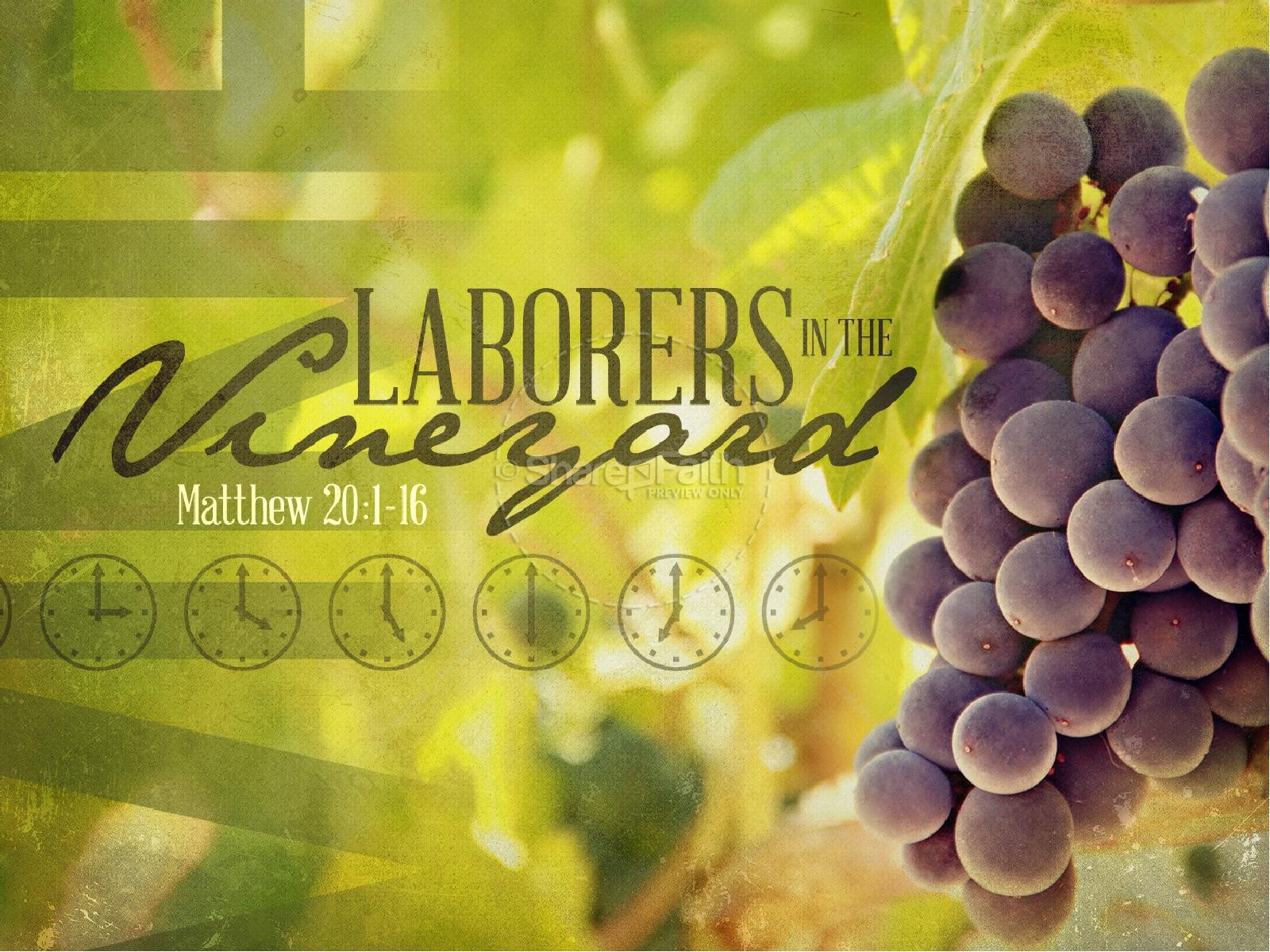
We’ve all heard it (or said it) before. On the playground, in the classroom, or at the dinner table…that famous phrase, second only in our early childhood vocabulary to the word NO!

That’s. Not. Fair.

We say it at work, home, school. We say it when we watch news, sports, or our neighbors. We say it when we’re outraged, offended, or scandalized.

That’s not fair.

We hear the same complaint from the workers at the end of Jesus’ parable of The Laborers in the Vineyard.

‘These last men have worked only one hour, and you made them equal to us who have borne the burden and the heat of the day.’ 

Did you hear it? We worked longer, harder, and accomplished more than those 11th hour bums. That’s not fair.

This parable reveals yet another shocking, outrageous truth: the Kingdom of heaven isn’t fair. But that’s a good thing. Fairness is the Law – you get what you deserve. Grace is Gospel, Good News of outrageous forgiveness for undeserving sinners – you get what you don’t deserve. And that’s the Kingdom of heaven. If fairness is what gets us into the kingdom of heaven, then it’s all on us. But if God’s grace is what gets us in, then that’s Good News. Salvation is God’s gift for you. The last are first. The guilty go free. Sinners are justified.

When Jesus tells this parable, the fairness police, or the Law-hungry Pharisee within each of us, is offended by this parable. It doesn’t fit into our way of thinking. “You get what you deserve. You reap what you sow. A day’s work for a day’s pay.” That’s how we think. That’s the way of the world, we say. And we expect God to play by our rules. To be fair.

This parable reminds me of another story, C.S. Lewis’s The Lion, the Witch, and the Wardrobe. When the Pevensie children are in Narnia, having supper with Mr. and Mrs. Beaver. The dinner conversation quickly turns to Aslan, the true King of Narnia, who would come to defeat the White Witch. When Lucy Pevensie finds out that Aslan is a Lion, she asks, “Is he safe?” Mr. Beaver replies, “Of course he isn’t safe. But he’s good. And he’s the king, I tell you.”

So, what about the Landowner in this parable, is he fair? Of course, he isn’t fair. But he is good.

Listen to the way Jesus begins his story:

“For the kingdom of heaven is like a landowner who went out early in the morning to hire laborers for his vineyard. (Think something like 6 AM) Now when he had agreed with the laborers for a denarius a day, he sent them into his vineyard. And he went out about the third hour and saw others standing idle in the marketplace,  and said to them, ‘You also go into the vineyard, and whatever is right I will give you.’ So they went.

Whatever is right, our English translations say. Better said, whatever is good, righteous, or better yet…justified. Remember that word later.

Again, the landowner goes out and does the same thing at noon and 3 PM (the 6th and the 9th hour). He found some laborers still hanging around and hired them for some unspecified just wage. And they agreed. At 5 o’clock, as the sun was setting, there was still work to do. So, he goes to a local bar where some deadbeat losers were hanging out all day doing nothing because no one hired them.

He said to them, ‘You also go into the vineyard, and whatever is right you will receive.’
6 PM finally arrives. It’s beer-thirty. The workers head to the steward to receive their money. And here’s where the fun begins.

The vineyard owner lines them up in reverse order, from last to first, from the eleventh hour losers to the first hour workers who agreed to work for a denarius a day. When they eleventh hour workers opened they pay envelope…surprise! A shiny denarius! Wow! One hour’s work and a full day’s wage.
Imagine what happens as the other workers start to hear the news. “He’s paying a denarius an hour!” The twelve hour workers at the end of the line are busy rubbing their hands together. Hmm…a denarius an hour. This is great! But as the workers are paid, reality kicks in. Everyone gets one denarius.
The workers are bumfuzzled at the Landowner’s behavior. But they’re also livid. “These last worked only one hour, and you have made them equal to us who have borne the burden of the day and the scorching heat. Imagine a youth soccer league where the last place team gets the same big trophy as the undefeated first place team, in that order. That’s crazy, ridiculous, not to mention…it’s not fair!
And then the vineyard owner pops the Gospel cork and pours a strong one. “Friend, I’m doing you no wrong. Didn’t you agree with me for a denarius a day? Take what belongs to you and go. It’s my money and I do with it what I please. If I choose to give these last ones a full day’s wage, what’s that to you? Or do you begrudge my generosity?”
You see, this parable is a story of Judgment and grace. Judgment for those who resent and reject God’s grace. And God’s grace given to all who least deserve it.
Like the workers, we expect God to be fair. But here’s the rub. If we want God to be fair, to deal with us according to our works, our achievements, our accomplishments and all the things we do, then we will be condemned. That’s fair. Those are the terms of the Law. The wages of sin is death. We love to keep score and carry our spiritual punch cards around with us, always comparing and measuring ourselves to others, especially their faults and sins. Thank God I’m not like that murderer, adulterer, homeless guy, illegal immigrant, and so on down our list.

It’s not fair, we say. How can God forgive someone like that? But he does.

Think about it…if God was fair, we’d all get what we deserve.

Thank God that his thoughts are not our thoughts, Nor our ways his ways,” as the prophet Isaiah reminds us. Thank the Lord we don’t get what we deserve.

Thank God, he’s not fair. Because if there’s room in the kingdom of heaven for hookers, murderers, and tax collectors; for Peter the denier and adulterous David, for doubting Moses and faithless Israel, the thief on a cross and 11th hour workers – then there’s room in the kingdom of heaven for me and you.

Like the 11th hour workers in the parable, we live off of the work of another: the Landowner who was crucified at the 3rd hour, who from the 6th hour was hanging on the cross under the heavy burden of our labors, as darkness covered the land, and at the 9th hour he cried out “It is finished” as he died to save you. By the 11th hour Jesus was taken down from the cross and laid in the tomb for you, his work on the cross complete for you.

Image result for christ the vineWith God we receive equal salvation for unequal work. A denarius just for being there, regardless of what you did. Everyone receives the same death and resurrection, the same Baptism, the same Body and Blood, the same forgiveness. All by grace through faith for Jesus’ sake.

So the last will be first, and the first last.

With these words “The first shall be last” – Jesus takes away our pride, and then takes away our despair by promising “the last shall be first”.

We’re the 11th hour workers, the last ones, the losers and failures, the broken sinners who make it into the kingdom by the skin of our teeth.


And this laborer, our savior Jesus, worked his hands to the bone and the nail for you. He worked himself to death for you. He rested from all the labors that he had done for you.
We who are the last ones are made first because He who was first became last for us. In his mercy, Jesus does not give us what we deserved – the wages of sin is death. And in his grace, Jesus gives us what we don’t deserve, the denarius of his forgiveness, life, and salvation. The Scriptures repeat this promise:

God demonstrates His own love toward us, in that while we were still sinners, Christ died for us. Romans 5:8

But to him who does not work but believes on Him who justifies the ungodly, his faith is accounted for righteousness. Romans 4:5

In this is love, not that we loved God, but that He loved us and sent His Son to be the propitiation for our sins. 1 John 4:10

Is it fair? No. He’s not a fair God, but he is good and righteous and in Christ you are justified.


In the Name of the Father and of the + Son and of the Holy Spirit. Amen. 

Wednesday, December 24, 2014

Christmas: Bigger on the Inside

When most people hear the phrase "it's bigger on the inside" their minds first jump to Dr. Who, the beloved time lord of BBC fame. However, this phrase is older than even the original Dr. Who and TARDIS. Here's a short list of some of my favorite things, tangible or otherwise, that are bigger on the inside. Feel free to comment below and add anything you think ought to be included.

Mary Poppin's purse.

My mother's purse (at least as a child).

The Weasley's tent.

Hermione Granger's backpack.

The entrance to platform 9 3/4.

The Holodeck on Enterprise.

A book, preferably one filled with adventure, fantasy, and imagination.

A hobbit's courage, especially Bilbo, Frodo, and Master Samwise.

The imagination.

The Wardrobe into Narnia.

The portrait of the Dawn Treader in Eustace Scrub's house.

The stable in The Last Battle.

"It seems, then," said Tirian, smiling to himself, "that the stable seen from within and the stable seen from without are two different places."

"Yes," said the Lord Diggory. "Its inside is bigger than its outside."

"Yes," said Queen Lucy. "In our world too, a stable once had something inside it that was bigger than our whole world.

So, on this Christmas Eve, it would seem that the list is incomplete without the two most important places that also qualify as bigger on the inside: The Virgin Mary's womb, and the manger wherein the Word made flesh is laid. And to this I would add a third, Christ's tomb for the Christ-Child is born that man no more may die. Born for our redemption, justification, and resurrection. Born to bear our sins on the cross and bury them forever in his tomb. 

For unto you is born this day in the city of David, a Savior, which is Christ the Lord.

A blessed bigger-on-the-inside-Christmas to you.


Monday, April 21, 2014

C.S. Lewis and the Grand Miracle of Easter


Note: Although there certainly are many more, here are a few of my favorite quotations from the writings of C.S. Lewis that only add to the joy and supreme gladness of this day.
 

On Miracles

In the Christian story God descends to reascend. He comes down; down from the heights of absolute being into time and space, down into humanity; down further still, if embryologists are right, to recapitulate in the womb ancient and pre-human phases of life; down to the very roots and seabed of the Nature He has created. But He goes down to come up again and bring the whole ruined world up with Him. One has the picture of a strong man stooping lower and lower to get himself underneath some complicated burden. He must stoop in order to lift, he must almost disappear under the load before he incredibly straightens his back and marches off with the whole mass swaying on his shoulders…

…In this descent and ascent everyone will recognize a familiar pattern: a thing written all over the world. It is the pattern of all vegetable life. It must belittle itself into something hard, small and deathlike, it must fall into the ground: thence the new life reascends…

…The doctrine of the Incarnation, if accepted, puts this principle even more emphatically at the centre. The pattern is there in Nature because it was first there in God. All the instances of it which I have mentioned turn out to be but transpositions of the Divine theme into a minor key. (C.S. Lewis, Miracles, p. 179-181).

Thus, as Lewis goes on to say in a later chapter:

He [Jesus] is the ‘first fruits,’  ‘the pioneer of life.’ He has forced open a door that has been locked since the death of the first man. He has met, fought, and beaten the King of Death. Everything is different because He has done so. This is the beginning of the New Creation: a new chapter in cosmic history has opened. (C.S. Lewis, Miracles, p. 237).

The Lion, the Witch, and the Wardrobe

“…though the Witch knew the Deep Magic, there is a magic deeper still which she did not know. Her knowledge goes back only to the dawn of time. But if she could have looked a little further back, into the stillness and the darkness before time dawned, she would have read there a different incantation. She would have known that if a willing victim, who had committed no treachery, was killed in a traitor’s stead, the Table would crack and Death itself would start working backward.” (C.S. Lewis, The Lion, the Witch, and the Wardrobe, p. 163).


Friday, April 4, 2014

Narnia in Pop-Book Format

As an adult, checking the mail is never as exciting as it was in one's youth. Most adults consider a good day of mail one that includes no junk mail, advertisements, or the dreaded curse word of grown-up life: bills. And yet peering into that mail box still seems, at times, to be a great adventure. Perhaps something unexpected will arrive, a letter from a friend or relative, an early arrival from Amazon, or a completely unforeseen gift. For me, at least, there's always a little bit of child-like wonder in going to the mail box. And so it was that on one such trip to the mail box recently, a happy occasion awaited me, a book in the mail that I did not order. Thanks to my good friend, Rod Zwonitzer at KFUO, Zoe and I received a copy of a pop-up book of C.S. Lewis' Chronicles of Narnia. Not only was this an unexpected gift, but it has continues to bring joy to Zoe each nigh we read itt: "I read dada's book?!" "Yes, Zoe, we can read the book." Here are the pictures of each page along with a few annotations and quotations.


This page is Zoe's favorite. The look on her face as she opens it to reveal Aslan's face is exactly that the same as that of the Pevensie children in Lion. Witch, and the Wardrobe, one of awe-filled fear and joyful giddiness. After all, he is not a tame lion. But he is good. And the fact that Zoe comprehends that without having read a page is simply amazing and worth watching over and over again just like reading the book.

 
When Zoe opens the little slide flap containing the White Witch, revealing the wardrobe, she once again perceives that the Witch is bad: "Oh no!" Granted, we've read the Lion, Witch, and the Wardrobe, but even two year olds know that witches are bad. It's like rediscovering Narnia all over again every time the page is opened.

For the page depicting The Horse and His Boy, we enjoy taking the reins and riding off into imaginary adventures, moving the pages to mimic the horse's pounding hooves, while I hear Zoe urging me on, "Mo page, dada. I see anuh page." And ever since reading about this particular part of the story, she has taken a greater affinity in riding upon my back up further up our stairs.


The Prince Caspian page has become more fun as we read as well. At first she didn't realize the presence of the animals. But now each detail rarely escapes her attention, right down to the sword, the magical horn, and the bad guy in the middle!


The Voyage of the Dawn Treader has always been one of my favorites (in addition to LWW) and this page certainly does not disappoint. It is fascinating to watch the imagination of a two year old at work as her eyes dart from the mermaids to the people on board the great vessel and then to the secret panel behind which Reepicheep hides.


Second to Aslan, I think Reepicheep (or Reesheep as Zoe says), is her favorite character. He certainly is one of mine just as he was for Lewis as well.


I'm a little surprised that the creators of this pop-up book chose to depict the parliament of owls instead of something from the under land or perhaps the freeing of Prince Rilian. Nevertheless, the owls are an important part of the story, and having Glimfeather soar off the page makes for superb reading with Zoe: "Hoo! Hoo!"


The last and final page, showcases the iconic scene from The Last Battle, where the animals stream through the stable door and further up and further in to the real Narnia. I couldn't think of a better illustration for the eschaton of the chronicles in pop-up format. The vibrant colors, key characters, and vivid imagination are all on display. Our nightly ritual of picking our favorite animals is usually accompanied by the ever-familiar request: "Dada, I read more book?! Gan. Gan. Gan." Apparently Zoe already appreciates a good fairy story, one that does not end but goes on and on, as each chapter is greater than the last.


Friday, March 21, 2014

Aslan's Living Water

Two women went looking for water. One was younger and the other was older. One went into the wood and the other to the well. One was from Narnia the other from Samaria.

Yet, these two women, Jill Pole and the Samaritan woman, have more in common than they do in contrast  Both had sinned. Both came face to face with the Lion who could not be tamed. Both were lost, thirsty, and alone. Both could find only one stream that would satisfy. Both received more than they expected. 

"If you're thirsty, you may drink."

...she had seen its lips move this time, and the voice was not like a man's. It was deeper, wilder, and stronger; a sort of heavy, golden voice. It did not make her any less frightened than she had been before, but it made her frightened in a rather different sort of way.

"Are you not thirsty? said the Lion.
"I'm dying of thirst," said Jill.
"Then drink," said the Lion.
"May I - could I - would you mind going away while I do?" said Jill. "Will you promise not to - do anything to me, if I do come?" said Jill.
"I make no promise," said the Lion.
"Do you eat girls?" she said.
"I've swallowed up girls and boys, women and men, kings and emperors, cities and realms," said the Lion.
"I daren't come and drink," said Jill.
"Then you will die of thirst," said the Lion.
"Oh dear!" said Jill..."I suppose I must go and look for another stream then."
"There is no other stream," said the Lion.

It was the coldest, most refreshing water she had ever tasted. You didn't need to drink much of it, for it quenched your thirst at once. (C.S. Lewis, Silver Chair, p. 556)

“If you knew the gift of God, and who it is that is saying to you, ‘Give me a drink,’ you would have asked him, and he would have given you living water.” 11 The woman said to him, “Sir, you have nothing to draw water with, and the well is deep. Where do you get that living water? 12 Are you greater than our father Jacob? He gave us the well and drank from it himself, as did his sons and his livestock.” 13 Jesus said to her, “Everyone who drinks of this water will be thirsty again,14 but whoever drinks of the water that I will give him will never be thirsty again. The water that I will give him will become in him a spring of water welling up to eternal life.” John 4.

You also have come to the streams of the great Lion, where living water flows freely from his side to you in the font. There is no other stream. There is no other well. For there is no need of any other. This Lion of the Tribe of Judah gives you true living water. Take and drink and live forever. Water is life. Jesus is your living water, from Samaria to all the ends of the earth, even to eternal life.

Saturday, December 28, 2013

Sermon for Christmas Eve Midnight: "Unto You"


+ Nativity of our Lord, Midnight - December 24th, 2013 +
Redeemer Lutheran, HB
Series A: Isaiah 9:2-7; Titus 2:11-14; Luke 2:1-20

In the Name of the Father and of the + Son and of the Holy Spirit. Amen.

In the beginning of C.S. Lewis’s beloved book The Lion, the Witch, and the Wardrobe the reader enters a wardrobe into the magical world of Narnia. But the wonder of this discovery is quickly overshadowed. There is a White Witch and Narnia is covered in a curse: it was always winter, but never Christmas.
Let that thought sink in a moment. What that would the world be like without Christmas? 

That would be like a ship at sea whose captain is never able to chart a course to safe harbor though surrounded by islands.
Or a hiker traversing up a mountainside only to find that when he ascended the top of one peak there was an endless mountain range on the horizon.
Or a person who finds themselves in a library packed floor to ceiling with the greatest books of all time but is incapable of reading a single word.
Think of Moses dying before entering the Promised Land, or Simeon waiting without any hope of fulfillment. Or, the words of Isaiah, had 8th century prophecy of Christ not come true…we would still be a people walking in darkness; living in sin; dwelling in a land of death.

No Christmas means no Mary or Joseph, no shepherds or angels, just an empty stable full of straw and animals. No Christmas, no God in human flesh. No Savior. No one living a perfect life for you, no one obeying the Law’s demands on your behalf, no one healing disease and casting out demons, no one preaching the Gospel and no Good Friday. No cross. No suffering. No death. No forgiveness. No resurrection. No life.

Take away Christmas – take away Jesus’ incarnation - and there’s nothing specifically Christian left.
What would the world be like without Christmas? Always death and no life. In a word…darkness.
Thankfully for us, God works his greatest rescues at night, out of the darkness. Have you noticed that as you read the Scriptures? It’s no accident.

God spoke the words, “Let there be light” into the darkness and void of creation.
God promised a rescue from the darkness of sin and death even after Adam’s fall.
God proclaimed that Abraham’s offspring would deliver all nations, as he gazed at the immeasurable night-sky.
God led Israel out of captivity and bondage to slavery as they sat in darkness preparing and eating the Passover meal.
God brought victory to Israel by twilight as Gideon’s lamps filled the Midianites with fear and confusion.
God sent his angels to the shepherds as the light of glory pierced the shadows of Bethlehem’s hillsides. 

Fear not, for behold I bring you good tidings of great joy that will be for all people. For unto you is born this day in the city of David a Savior, who is Christ the Lord.

The people who walked in darkness
have seen a great light;
those who dwelt in a land of deep darkness,
on them has light shone.

For the grace of God has appeared, bringing salvation for all people. And you will find him wrapped in swaddling clothes and lying in a manger.

Christ’s incarnation is the grand miracle of the Christian faith: the uncreated, eternal, came into nature, into human nature, bringing nature up with Him (C.S. Lewis). The Creator becomes the Creature. The Infinite takes up residence in the Finite. The fullness of the Deity dwells among us bodily. God and Man are reconciled. The image of God is restored to Man. Uncreated Light comes to cast out the darkness of our sin.

Of course, this means saying the politically incorrect and impolite thing and owning up to our sin. Calling our sin what it is: darkness, damnable, and death. Isaiah was also prophesying about us. We sit in deep darkness. But that’s only half of the prophet’s words. Don’t stop there. There’s no need to sit in the darkness holding onto your precious sin anymore. Unto you a child is born! 

Oh, come, ye unfaithful,
Broken and polluted!
Oh, come ye, oh, come ye,
To Bethlehem!
Come and behold him,
Born the friend of sinners:
Oh come let us adore him,
Christ the Lord!
(Chad Bird)

We must do away with any pious notions of “God up there” and “we down here” or of our reaching up to God. What we cannot do, God has done. God has come down to us in the Child of the manger. We cannot ascend to God, either in our thoughts, prayers, dreams, or faith, but God has come down to us. We cannot reach up to God, but God has extended His right Arm to us. We cannot crawl our way out of sin’s fell darkness, but God crawls his way to us.

Luther once said, “I know no other God than the One who hangs on a cross and nurses at the breast of His mother.” This is the profound miracle of the Incarnation. No other world religion can make – or dares to make – this historical, monumental claim. God and Man are One in the person of Jesus. God of the eternal Father, Man of His virgin Mother, Jesus brings God and Man together as one unique Person, a new Adam, a new Head for humanity. Unto you is born a Savior.

So if you think about it: Jesus isn’t the reason for the season. You are. Jesus wasn’t born for himself. Jesus didn’t live for himself. He had no need to die for himself. He did it all for you. Christ became man for you. Christ lived a perfect life for you. Christ paid the debt of your sins, suffered for you, bled for you. Christ hung on the cross in darkness for you. Christ delivered you from the shadow of death by dying for you. All of God’s night-time rescues of old – for Abraham, Israel, and Gideon - all lead down to the cross. 

All because Christ was born for you.
Unto you is born a Savior who is Christ the Lord.
Unto you is born the Light of the World to scatter the darkness of your sin and death… far as the curse is found.
Unto you is born the true Fountain of Life who baptizes you with living water and sacred blood, flowing from his pierced side.
Unto you is born the One who speaks a word of absolution over your sins as quickly and surely as he spoke creation into being.
Unto you is born the Word made flesh who gives His flesh for you to eat and his blood for you to drink. 

Here is the true Christmas celebration – a Christmas feast - where Christ’s Word is preached and heard, where His Body and Blood are given and received, where the Word made Flesh continues to dwell among us.  

Tonight, there’s no need to wonder what the world would be like without Christmas ever again.
Here it is always Christmas and never winter. For sin’s curse is broken, Hell is defeated, and the shadow of death is lifted, pierced by the holiness of newborn light from a cave in Bethlehem. It’s Christmas and the Christ-child is on the move. All darkness flees at his birth while hasten to join the shepherds in rejoicing. 

For unto you is born a Savior who is Christ the Lord.

A Blessed Christmas to you all…

In the Name of the Father and of the + Son and of the Holy Spirit. Amen.