Monday, June 16, 2025

Sermon for Trinity Sunday: "The Triune God of Abraham"

 + Trinity Sunday - June 15th, 2025 +

Series C: Proverbs 8:1-4, 22-31; Acts 2:14, 22-36; John 8:48-59

Beautiful Savior Lutheran Church

Milton, WA


The Trinity | Elsecar Holy Trinity CofE Primary Academy Elsecar Holy Trinity  CofE Primary Academy


In the Name of the Father and of the + Son and of the Holy Spirit. Amen.


Your father Abraham rejoiced that he would see my day. He saw it and was glad.


This is what Jesus says to the Jews near the end of their rather lengthy debate over his identity and divinity, a debate that takes up a better part of John 8, until Jesus lays down his final arguments in the debate by claiming to be YHWH in the flesh, the Great I AM incarnate. 


And it makes you wonder…what was it that Abraham saw about the coming Messiah, Jesus Christ, that would cause him to rejoice and be glad. After all, Abraham saw many things.


Could it have been when YHWH called Abram to leave his father’s house and go to the land God would give him? Or when he promised…I will make of you a great nation and I will bless you and make your name great? Or when YHWH caused a deep sleep to come upon Abram and made his covenant with him and promised to send him a son through whom all nations would be blessed? 


Could it have been when Abram and Sarai were given new names or when YHWH delivered on his promise and gave Abraham and Sarah their beloved son, Isaac? Or when YHWH rescued Abraham and Lot and their families from the destruction of Sodom, or on the mountain where YHWH told Abraham to bring his only son, Isaac, whom he loved, for a sacrifice but the Lord provided another sacrifice?


Yes…all of the above.


Your father Abraham rejoiced that he would see my day. He saw it and was glad. Abraham rejoiced and was glad because the God who called him also calls you, out of this dark and dying world into the new creation in Christ ushers in on the cross and out of the grave.


Abraham rejoiced and was glad because the same God who promised to bless him and make his name great has a greater name which is above all names: the Name of the Holy Trinity, which we confess and rejoice in today: Father, Son, and Holy Spirit. And because the God who made his covenant with Abraham, is the same God – Father, Son, and Holy Spirit, who brings you out of the sleep of death, and the darkness of sin, in the covenant and promise of Holy Baptism. There he places his eternal, holy, Triune name upon you.


Abraham rejoiced and was glad, because even though his sin, and yours and mine is as numerous as the stars in the heavens, the steadfast love of the Lord is far greater; and in his mercy he calls us children of Adam to be children of God. The same Lord who gave him and Sarah new names, has also given you a new name: saint, baptized, beloved, heir…all by the work his saving name accomplishes for you. The name that we confess today: Father, Son, and Holy Spirit. 


Abraham rejoiced and was glad because the same Lord who promised the birth of Isaac himself was delivered, born of the Virgin Mary, a child of promise born to save Abraham and you. And this beloved Son of God, born of Mary, is also the only begotten Son of the Father, …and one substance with the Father. He and the Father are one. And the Spirit proceeds from the Father and the Son to you. For the same Lord who rescued Abraham and Lot and their families, came to live, suffer, die, be buried, and rise again to bring you into his family and make you members of his holy household by grace. The Father sends his Son for you. The Son gives his life for you. The Spirit is poured out for you to bring you back to the Father through the Son.


Abraham rejoiced and was glad because he saw from afar the dawning day of the greater Isaac, the only begotten Son of the Father, who was not spared on the mountain of sacrifice but gave his life for Abraham, Isaac, and for you. Abraham saw who Jesus is. The Jews in John 8 do not. Standing before them was the one who was before Abraham, who is and who was and who is to come, the great I AM incarnate who declares to you…I AM the resurrection and the life.


There’s no middle ground when it comes to Jesus’ words here in John 8. Either they are the height of blasphemy and the Jews were right to pick up stones and hurl them in his direction…or Jesus is exactly who he says he is…that he and the Father are one, and he is God in the flesh to save you, sent from the Father and sending of the Spirit. 


This is the holy confession we echo in the Creeds today and every Sunday. That we worship the Trinity in Unity, and the Unity in Trinity, neither confusing the persons nor dividing the substance. 


The question isn’t about whether or not we can perfectly understand this mystery. We can understand it no better than the Jews in John 8 ready to stone Jesus. The question isn’t whether or not  you can explain Jesus’ words or the mystery of the Trinity, but do you believe this confession? Do you trust his words? Do you believe him when he says that he and the Father are one? Do you believe him when he says, before Abraham was, I AM? Do you trust that he - and he alone - is the one whose words are life and whose life is given to you that you would never see death (the big D, everlasting, Death)? 


And with those famous father’s words, we confess…Lord, I believe, help my unbelief. I believe that I cannot by my own reason or strength believe in Jesus Christ my Lord or come to him. But the holy Spirit calls, gathers, enlightens, sanctifies, and keeps me in the faith, just as he did for Abraham. The Lord Jesus gives you what you lack, just as he did for Abraham. The Lord Jesus gives you a righteousness that is not your own, just as he did to Abraham. For what does the Scripture say? “Abraham believed God, and it was counted to him as righteousness.”


As it was for Abraham, so it is for you. Today you confess and rejoice and are glad in the work and mystery and saving rescue the Holy Trinity brings to you in Jesus. Today you confess that the God of Abraham, Isaac, and Jacob is also the God who is the Holy Trinity - Father, Son, and Holy Spirit - to save you by grace. Rejoice and be glad, for with Abraham and all the saints you confess and live in the saving name of the Holy Trinity, and the undivided unity.


A blessed Trinity Sunday to each of you…


In the Name of the Father and of the + Son and of the Holy Spirit. Amen.


Monday, June 9, 2025

Sermon for Pentecost Sunday: "The Preacher"

 + Pentecost Sunday – June 8th, 2025 +

Series C: Genesis 11:1-9; Acts 2:1-21; John 14:23-31

Beautiful Savior Lutheran Church

Milton, WA


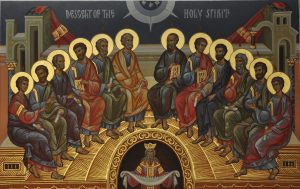
The Origins and Practices of Pentecost | Boston Public Library


In the Name of the Father and of the + Son and of the Holy Spirit. Amen.


We probably all know someone, a friend, family member – maybe it’s the man or woman in the mirror – who loves to talk about one thing and one thing only. Every conversation. Every text. Every social media post. Every phone call. It’s always groundhog day and the topic is always the same. 


I had a friend in high school like this. No matter the class – history, algebra, biology, or theology – he found a way to talk about the cartoon show, The Simpsons. 


Strange as it sounds, this is a perfect picture of the work of the Holy Spirit – and not just on Pentecost – but in the Church through the word and the forgiveness of sins. 


If the Holy Spirit were a radio station DJ, every song, every playlist, every hour of airtime would be given to playing this one song over and over again: For the wages of sin is death, but the free gift of God is eternal life in Christ Jesus our Lord.


If the Holy Spirit were the film operator at your local theater, the one movie he would play over and over again is the true story of the Lamb of God who takes away the sin of the world.


If the Holy Spirit were your professor, every assignment, every lecture, book, paper, and quiz would be on this teaching: And to the one who does not work but believes in[a]him who justifies the ungodly, his faith is counted as righteousness. 


This, says Jesus, is the work of the Holy Spirit. He will glorify me, for he will take what is mine and declare it to you. Who does the Spirit glorify? Speak about? Point to? Who is the topic of every word of ever page of every book in the Scriptures? Not your favorite topic and mine, ourselves. But Christ. Always Christ in his blood shed for you and his dying and rising for you.


When Jesus teaches his disciples about the Holy Spirit in John 14, he also teaches you what he sends the Holy Spirit to do. the Helper, the Holy Spirit, whom the Father will send in my name, he will teach you all things and bring to your remembrance all that I have said to you. 


And the Holy Spirit is sent to be the preacher and teacher of Christ; his work is to give you Christ. The Holy Scriptures and the font and the altar and the absolution are the Holy Spirit’s pulpit where he constantly, ceaselessly, and graciously proclaims and gives and points you to Christ.


The Spirit is your Helper, Jesus says. Your Advocate. Your teacher, whose chalk board is full of illustrations and arrows pointing you to the crucified Son of God who bled and died for you.


The Holy Spirit draws your attention away from yourself, which is where you and I always want it to be, and draws it back to Christ. The Holy Spirit brings you out of death and your countless idols to Christ. The Holy Spirit gives you a Christ-centered fixation. The Holy Spirit brings you Christ. Teaches you Christ’s word. Preaches Christ’s promises to you. Gathers you in Christ’s Church. Pours out Christ’s dying and rising for you in water and word. Raises you from the dead in Christ in the forgiveness of sins. 


This is what that word holy means in the Holy Spirit. It is the work of the Holy Spirit to make holy what is unholy. To sanctify sinners. To raise you from the death of sin to life in Christ. To sanctify you is to bring you to Christ. To receive what you and I cannot and would not have on our own. The Holy Spirit is not the helper in the sense of lending you a hand up, or like when you tell your child, “You have to use your own legs to get up; I can’t lift you by myself.” 


No, the Holy Spirit does all the heavy lifting. Does all the raising from the dead. Carries us all the way to Christ. Or, as you learned in the Catechism. I believe that I cannot by my own reason or strength believe in Jesus Christ, my Lord, or come to Him; but the Holy Spirit has called me by the Gospel, enlightened me with His gifts, sanctified and kept me in the true faith…in the same way he calls, gathers, enlightens, and sanctifies the whole Christian Church…where he daily and richly forgives my sins and the sins of all believers.


That’s you. That’s me. This is what the Holy Spirit is sent to do. Holy Spirit is sent to be the preacher and teacher of Christ; his work is to give you Christ. It’s the Holy Spirit gives you faith in Christ. Preserves your faith in Christ. Keeps you in the faith in Christ. Works day in and day out until the Last Day of the Resurrection to bring you to Christ. And all of those good works and fruits of faith Scripture talks about…those are all the work of the Spirit as well, filling you with the love of Christ.


How does the Holy Spirit do all of this? Not by your faith, but by his faithfulness and the faithfulness of Jesus for you. Not in your feelings; the Holy Spirit isn’t Yoda telling you to search your feelings…but in the sure and certain Word of God, which is where promises to speak and teach and proclaim Christ for you. Not in your works, but by his work which he binds and ties to things you can hear, touch, taste, see, smell…words from the Scripture that give you Christ. Water and word which gives you Christ – as it did for Jane today. Bread and wine that give you the body and blood of Christ. 


Jesus’ words in John 14 give us a marvelous picture of what the Holy Spirit is sent to do in Christ’s Church, day in and day out until the Day of Resurrection. The Helper, the Holy Spirit, whom the Father will send in my name, he will teach you all things and bring to your remembrance all that I have said to you. 


The Father sends the Son. The Son lives and dies and suffers and rises for you. The Spirit is sent through the Father and the Son in the name of the Son, to bring you to Christ. Give you Christ. 


This is the Holy Spirit’s constant refrain: Christ for you.


A blessed day of Pentecost to each of you…


In the Name of the Father and of the + Son and of the Holy Spirit. Amen.


Monday, June 2, 2025

Sermon for Easter 7 (Confirmation Sunday): "The Name"

 + 7th Sunday of Easter (Confirmation Sunday) – June 6th, 2025 +

Series C: Acts 1:12-26; Revelation 22:1-20; John 17:20-26

Beautiful Savior Lutheran Church

Milton, WA


John 17:1-5 – The Beginning of Jesus' “High Priestly Prayer” | Biblical  Chiasmus


Alleluia. Christ is risen!


In the Name of the Father and of the + Son and of the Holy Spirit. Amen.


Jesus prays in John 17, I made known to them your name, and I will continue to make it known, that the love with which you have loved me may be in them, and I in them.


A name is a gift. It isn’t chosen or earned. A name is revealed. Made known. Given. When you name something or someone a gift is given. So your parents did for you when they named you – perhaps a family name or a name that had meaning or beauty. God gave Adam the sacred task of naming the animals brought to him in creation in Eden. Where do we learn this sacred gift of naming? Where does this gift of names come from? 


From the one who gave Adam and you your name in the first place. From the Name above all names. The Name of God – Father, Son, and Holy Spirit. The Holy Trinity is the great giver of names. 


Remember, a name is a gift. It is made known. Given. So it is with God’s name throughout the Scripture. The Lord reveals his name to Moses in the burning bush. YHWH. I AM WHO I AM. Say this to the people of Israel: ‘The Lord, the God of your fathers, the God of Abraham, the God of Isaac, and the God of Jacob, has sent me to you.’ This is my name forever, and thus I am to be remembered throughout all generations.


YHWH places his same revealed name upon the stones that adorned the priests’ vestments in the tabernacle and temple. YHWH places his name at the beginning of the commandments…I AM YHWH who brought you out of the land of Egypt, out of the house of slavery.


When YHWH instructs Moses to build the tabernacle, he promises that in the place where he promises to put his name there he will be present and there he will bless.


So it is when YHWH of the burning bush and the pillar of smoke and fire is incarnate and born of the Virgin Mary. YHWH reveals his name once again. His name is Jesus, for he will save his people from their sins, the angel tells Joseph. 


There is no other name under heaven given among men by which we are saved, preaches Peter. 


YHWH reveals and makes known and gives his name. It is his gift given to you. It’s more than a nametag by which he is known. His name brings his peace. His name is his presence to save and rescue. His name means he dwells with you and for you. His name brims with promise. His name is backed by his authority over death and the grave.


This is the name by which you are saved – Father, Son, and Holy Spirit. And this is the name, Jesus prays in John 17, that he has revealed and given to his disciples. But not only his disciples. He reveals and gives his name to you as well. 


Jesus is praying for you in this part of his high priestly prayer. And we need this prayer. This word from Jesus. We need his name upon us. Over us. Surrounding us. Because it’s tempting for you and I to go the way of the men of the tower of babel and make a name for ourselves. To confess and exalt and take pride in our name and call upon our own name in the day of trouble. To do what is right in our own eyes. 


This is why Jesus must reveal God’s name for us. The Trinity must make himself known to us. God gives us his name like a light into the darkness. Like life from the dead. Like water in the wasteland. And this he delights do to. 


I made known to them your name, and I will continue to make it known, that the love with which you have loved me may be in them, and I in them.


What Jesus prays for is what he does for you. YHWH names you. He gives you a name you didn’t earn or deserve or choose or make for yourself. He has made and chosen it for you. For it is his name placed upon your forehead by water and word and the Spirit.


I baptize you in the Name of the Father and of the Son and of the Holy Spirit. This is the name he reveals in Scripture and the name he gives you. The Lamb’s name written upon your forehead and heart.


This is the name that you – like our catechumens today – received on the day of your baptism. The name that saves you. The name that you – as they do today – confess the faith in. The name by whose grace you intend to live according to his word and continue steadfast in this confession and suffer even death for his name rather than fall away from it.  


Yes, confirmation day is a day for naming things. For receiving gifts in the name of YHWH – Father, Son, and Holy Spirit. It is for you as it was on the day of your baptism. Today you remember whose you are. Whose name belongs to you. Whose name you are baptized in. Whose name you confess. And whose name has written your name in the Lamb’s book of life. 


Today, tomorrow, and forever, Jesus reveals his name and makes it known to you and gives you his saving name to live in, to confess, to call upon in prayer, to give you his blessing, promise, and presence…now and always.


In the Name of the Father and of the + Son and of the Holy Spirit. Amen. 
Tuesday, May 27, 2025

Sermon for Easter 6: "In Jesus' Name"

 + 6th Sunday of Easter – May 25th, 2025 +

Series C: Acts 16:9-15; Revelation 21:9-27; John 16:23-33

Beautiful Savior Lutheran Church

Milton, WA


What was Jesus' real name?


In the Name of the Father and of the + Son and of the Holy Spirit. Amen. 


“Prayer,” wrote Lutheran pastor, Dietrich Bonhoeffer, “begins not in the poverty of our hearts but in the richness of the word of God.”


Yes, you say the words and pray the prayers, but if your prayers are like the framing of a house, they are not built on the quicksand of your heart, but on the solid rock foundation of Christ’s promise and name. Prayer – like every other gift from God – is also given, sustained, and granted by his good and gracious will. 


That’s why, when you learn to pray it’s not all that different from the same way you learned to speak when you were younger. A child learns to speak when his father speaks. Dad or mom say words and the child says the words back to them. Sometimes over and over…again and again. So it is with God’s gift of prayer. You learn to speak to God in prayer because God the Father has spoken and speaks to you in his word. You learn to pray by hearing and receiving his word. 


With our heavenly Father’s words, you his children, learn to speak with him. Repeating God’s own words after him, you begin to pray.


When you pray it is also at Jesus’ invitation. Always on the basis of his promise. Always anchored in his cross for you and his resurrection for you. 


This is one of the great and gracious and mysterious gifts Jesus gives his disciples – then and now – in John 16. 


Truly, truly, I say to you, whatever you ask of the Father in my name, he will give it to you. 


The more you think on these words the more astonishing you will find them. Jesus is giving you something that you and I on our own have no basis to claim apart from Jesus’ promise and blessing. Outside of Jesus’ name and his dying and rising…You and I have no rights or merits or demands to make and bring before him in prayer. 


We come as beggars before God and have no right to ask him anything. As you learn in the Catechism. We are neither worthy of the things for which we pray, nor have we deserved them, but we ask that He would give them all to us by grace, for we daily sin much and surely deserve nothing but punishment.” And yet, Jesus invites us to pray – not in our name – but in his name. 


To call pray in the name of Jesus…to come before the Father in prayer…is not a right in the way we think of them…like the bill rights or the amendments of the constitution. Prayer, like all of God’s gifts is a blood-bought gift to you in the death and resurrection of Jesus. Prayer belongs to you not by right, but by Jesus’ redemption. Not by your merits, but by his mercy. Not by your goodness, but by his grace to you in Jesus. Not in your name, but in his name.


To do something in the name of someone is a recognition that the name comes with authority or a claim by which you can do certain things. Think of an ambassador to a foreign nation given the authority or name of the United States to negotiate peace or a trade deal. Or think of the old stories when a messenger was sent throughout the kingdom with a decree and it was read in the name of the king. 


To pray in the name of Jesus means to pray under his name. To pray under his authority and with his blessing. To pray in the name of Jesus means to ask for the things Jesus gives and desires for you. 


You see, then, how astonishing and gracious this gift is. To pray in Jesus’ name is not to pray on the basis of your own name, but his. He grants you an authority and a blessing and a claim that is not your own but he makes it your own in his dying and rising. It’s just like his righteousness. You are given and clothed in a righteousness that is not your own, but his. So it is with prayer. 


That’s why to pray in Jesus’ name isn’t some kind of mystical or magical formula you include in the end of the prayer – like rubbing the magic lamp three times to get the genie to grant you your wishes like Janis Joplin sang…O, Lord won’t you buy me a Mercedes Benz. No. Jesus’ name isn’t given as an incantation, but for intercession. 


To pray in Jesus’ name means to pray in faith in what he has done for you when he died for you, atoned for your sins, and rose from the grave. It means to pray in faith in Jesus who gives you such gifts as prayer and his promises in his word, water, body and blood. 


Praying in the name of Jesus means you pray, not on the basis of who you are and what you’ve done, but who he is and what he has done for you. 


Praying in the name of Jesus means to pray as he has taught you, and in the name of him who is your Savior. That is, we pray for what Jesus wants and desires for us. For the things that would draw you to him. For the things that give you his grace and mercy.


To pray in the name of Jesus is to pray as our Lord prayed in Gethsemane before his suffering and dying on the tree…Lord, not my will, but yours be done.


There in the garden Jesus was praying for you. On the cross while bleeding and suffering and dying for you, Jesus was praying for you. On the throne as God-man, Jesus your advocate and mediator is always praying and interceding for you. 


This is why Jesus’ invitation and instruction to pray is so remarkable and gracious. When he says pray this way, “Our Father,” He invites you, as you learn in the catechism, to sit next to him on the throne of heaven as a brother – you and I who were wayward, lost sons and daughters - and call upon God as Father. For he tenderly invites us to believe that he is our true Father and we are his true children, so that with all boldness and confidence we may ask him as dear children ask their dear father.


This is good news…when your prayers falter…Jesus prays for you. When your prayers are like you and I are – saints and sinners kinds of prayers – they’re all covered in the blood of Jesus. When your prayers are good, bad or ugly, your prayers – like the rest of you, are washed in the blood of the Lamb. And you live and work and pray and die and rise…all in the name of Jesus.


In the Name of the Father and of the + Son and of the Holy Spirit. Amen.


Monday, May 19, 2025

Sermon for Easter 5: "A Little While"

 + 5th Sunday of Easter – May 18th, 2025 +

Series C: Acts 11:1-18; Revelation 21:1-7; John 16:12-22

Beautiful Savior Lutheran Church

Milton, WA


The Reality of the Resurrection: The Purpose of the Resurrection - Family  Radio


In the Name of the Father and of the + Son and of the Holy Spirit. Amen.


One of the things that makes Christianity unique is that it makes no attempt to hide or dismiss suffering and sorrow. Suffering and sorrow are not illusions. They are often all too real and all too painful. Christianity is no stranger to sorrow and suffering. Jesus even says it plainly: “you will weep and lament while the world rejoices…you will have sorrow.”


You see it in the psalms of lament: “How long, O Lord?”

You see it in the apostles…Peter imprisoned and crucified upside down. John, exiled on Patmos, His churches were under siege. Christians tortured and martyred. False teachers wormed their way into the churches deceiving Christians with their seductive lies. The fabric of society was coming apart at the seams. Government was corrupt, the family was weakened, immorality reigned. Everyone did whatever they thought was right in their own eyes. 


You see it in Paul who was shipwrecked, beaten, whipped, rejected by his own people, expelled from the synagogue; he was no stranger suffering imprisonment, riots, false teachers, problematic churches. You name it, Paul probably suffered it.


You see it most clearly of all in our Lord Jesus who runs and dives head first into a deep end of unimaginable pain and sorrow and suffering…but he does so willingly and lovingly for you. Jesus does not dismiss or sweep your suffering and sorrow under a rug. He joins you in it. Suffers with you and for you.


Jesus, the man of sorrows, joins you in your suffering and sorrow and brings real joy even in the midst of real suffering. Jesus makes his suffering your own so that in the midst of your own suffering, he makes your sorrows his own.


This is why he says the things he says to his disciples on John 16. It’s the night of his betrayal. Jesus teaches. Jesus prays. Jesus gives the new covenant of his body and blood. Jesus tells them, “A little while, and you will see me no longer; and again a little while, and you will see me.” What does this mean? They say? Who could blame them. You and I would be right there asking the same question. What’s he talking about, a little while?


In that moment, they may not know, but Jesus knows. Jesus looks at their confused, scared, bewildered faces and knows what they and he are about to suffer. He knows their fears and uncertainty and sadness. He knows the suffering he is about to endure, the jeers, the whip, the torn flesh, the blood dripping, the anguish, pain, and agony. He knows the sorrow that will overwhelm them as they scatter for fear and denial, as the stone is rolled over Jesus’ tomb. You will weep and lament and the world will rejoice. 


Jesus is speaking about his impending death and resurrection. A little while they would see him no more. Crucified. Dead. Buried. But in a little while they would see him again. Risen. Glorified. Appearing before them in the upper room and by the seashore and on the road to Emmaus. Good Friday sorrow gave way to Easter joy. Anguish gave way to cries of “He is risen!” 


But Jesus’ words aren’t only for his disciples. “A little while, and you will see me no longer; and again a little while, and you will see me.” That’s for us too. We find ourselves living in “a little while” for the day when we will see with our own eyes Christ’s return in glory. Just as the disciples were caught between the “now” of not seeing and the “not yet” of seeing, between Good Friday and Easter Sunday, so we too find ourselves caught between the “not seeing” of Ascension Day and the “seeing” of Resurrection Day. The Last Days.


We live in the time of “the little while.” And so Jesus has the same words for us as he did for his disciples. You will weep and lament…and you will have sorrows. In this life, it’s not if, but when you suffer and have sorrow. 


For you, the baptized Christian, suffering and sorrow are not an illusion – it’s real. Sometimes all too real. Sometimes it lasts a few days, weeks, even years. Sometimes our suffering and sorrow do not go away with the dawn. Sometimes time doesn’t heal all wounds. You and I may not be Paul or Peter or John, but you suffer all the same. You endure sleepless, restless nights. You know the sorrow of a dark, painful, lonely night. You know the sorrow of empty chairs at your dinner table where family used to sit. Empty houses where loved ones used to fill the halls with laughter. You know the sorrow and suffering of illness that doesn’t quit no matter how many prayers and medications you hurl at it. You know the sorrow and uncertainty of losing a job and wondering what will I do next to care for my family. You know the suffering and sorrow of a child or grandchild who seems to have walked away from the faith. Like the disciples, you know moments or days or years of suffering, uncertainty and sorrow.


It’s not a lack of faith that these things happen. It’s not a failure to pray. No. Suffering and sorrow come from living in the “little while” between Jesus’ resurrection and ascension and his coming on the last day. And until that day there is, as our Lord promises, suffering and sorrow. The Christian life isn’t always hakuna matata and don’t worry be happy, and all joy all the time. 


Whatever it is that hurts. Whatever that is that makes you cry. Whatever it is that is too overwhelming to deal with. These are the very things Jesus went to the cross for. These are the very things Jesus died for. Jesus didn’t give these words to make you forget your sorrows. Jesus gave you these words so that you would know that it is okay to feel your sorrows. It’s okay to shed tears. It’s okay to mourn your dead. It’s okay to cry out in your pain. Because those are the places where Jesus goes. Those are the things Jesus bears. Those are the times Jesus promises not to leave you alone. 


Suffering is real. The pain is real. The hurt and sorrow are real. But so is this: Christ’s promise to you in your suffering. Christ’s gift of joy that no amount of suffering or sorrow can rob you of. Christ’s dying and rising for you, bringing his suffering into the midst of yours. Taking your suffering and sorrow upon himself. “You will have sorrow now, but I will see you again and your hearts will rejoice, and no one will take your joy from you.”


Even now as we live in the “little while” we live in, Jesus promises…Behold, I make all things new.


Even now in this life of suffering and sorrow…you have the joy of Jesus’ dying and rising, which means that…the sufferings of this present time are not worth comparing with the glory that is to be revealed to us. 

For I am sure that neither death nor life, nor angels nor rulers, nor things present nor things to come, nor powers, nor height nor depth, nor anything else in all creation, will be able to separate us from the love of God in Christ Jesus our Lord.

In the Name of the Father and of the + Son and of the Holy Spirit. Amen.

Monday, May 12, 2025

Sermon for Easter 4: "The Good Shepherd is For You"

 + 4th Sunday of Easter – May 11th, 2025 +

Series C: Acts 20:17-35; Revelation 7:9-17; John 10:22-30

Beautiful Savior Lutheran Church

Milton, WA


Christ the Good Shepherd Icon


Alleluia! Christ is risen!

In the Name of the Father and of the + Son and of the Holy Spirit. Amen.


You can tell a lot about someone by their voice. Are they sad, angry, anxious.  Joyful, excited, or hopeful. Is their voice soothing or harsh, hurtful or comforting. Whatever it may be, we come to know a lot about what someone by their voice.


This is also true when you turn to the Scriptures. Today’s gospel reading in John 10 reminds us that God, too, has a voice. God speaks. Jesus fills your ears with his voice by his word. 


Today Jesus the Good Shepherd comes to you with his voice and speaks his word of promise. The voice of Jesus is the voice of the Good Shepherd. And his voice is full of compassion. Comfort. And Consolation.


My sheep hear My voice, and I know them, and they follow Me. And I give them eternal life, and they shall never perish; neither shall anyone snatch them out of My hand.


Jesus spoke these words in the temple at Jerusalem, during the Feast of Dedication. We know it as Hanukah. Jewish people gathered to remember a time of deliverance. Almost two hundred years ago, Antiochus Epiphanes had desecrated the Temple. He set up pagan altars to Zeus in the temple and brutally oppressed the Jewish people. They, fought back, however, in the Maccabean revolt. The temple was recaptured and reconsecrated to the Lord. At the Feast of Dedication, Israel gathered in Jerusalem and remembered the overthrow of Israel’s enemies and the rededication of the temple.


On this day, however, God in the flesh walks in the Temple. Jesus strolls along the colonnade and looks out, over the people. He sees their joy, and he desires that their joy might be full in Him. So, Jesus recalls another war, an ancient war, and promises His people a greater victory. It is a future victory, His victory. Not in a fight over stones which make up a Temple, but in a fight for their lives, and yours, in his kingdom.


While Jesus was walking in the temple, the Jews surrounded Him and said to Him, “How long do You keep us in doubt? If You are the Christ, tell us plainly.”


You can know a lot about someone by their voice. And this, Jesus says, is the voice of unbelief. They have seen and heard God’s voice in action in Jesus’ teaching and signs. And yet, Jesus says, “I told you, and you do not believe. The works that I do in My Father’s name, they bear witness of Me. But you do not believe, because you are not of My sheep, as I said to you. 


If the voice of the Jews in John reveals their unbelief, what does your voice reveal about you? At times your voice reveal that you are wandering, lost, and straying sheep in need of a shepherd who will deliver us from ourselves. Other times, that you, like sheep, have a mean, stubborn, prideful, streak; you’re constantly butting and kicking one another to get your way. All we like sheep have gone astray. Everyone has turned his own way. That’s the problem. You love yourself – and so do I - and want to be your own shepherd and yet constantly fail at being our own shepherds. 


Still, at other times, your voices reveals that you are wounded sheep in need of rescue from suffering, pain, agony, sadness, and loss. Past or present trauma brought upon you haunts and cripples. Despair and the daily battle with mental health wears you down. Pain and grief overwhelms you. 


Or perhaps your voice reveals a sense of hopelessness and hurt…by what you’ve done or left undone. What’s been done or left undone by others. Or there’s that nagging voice of emptiness and despair. 

It seems the sinful flesh has no shortage of voices that scream and cry out in brokenness.


But into the din of all this noise, Jesus the Good Shepherd, your Good Shepherd, enters in. He speaks. Jesus fills your ears with his voice. 


“My sheep know My voice.” He says, “I know you, and you follow Me. I give you eternal life, and you will never perish, and no one will snatch you out of My hand”


The Devil and the world and your sinful flesh try and claim you, try and fight and snatch you from God's hand. But Christ promises: “My sheep know My voice.” He says, “I know you, and you follow Me. I give you eternal life, and you will never perish, and no one will snatch you out of My hand”


Whatever suffering you see, whatever tribulation you touch, whatever evil you endure, Jesus is with you. His voice. His word. His life. He holds you and carries you through.  


Yes, you can tell a lot about someone by their voice. Jesus’ voice reveals God’s compassion and assurance; his grace and rescue. Jesus’ voice gives you life. 


Even as Jesus was walking in the colonnade of the temple that day during the Feast of Dedication, he was on his way to overthrow your enemies of sin, Satan, and the grave; he was preparing for the greatest victory and rescue of all in his dying and rising for you. He would return to Jerusalem at the feast of the Passover so that the Good Shepherd would come and lay down his life for you, his sheep. So that Christ the true Passover Lamb, would be sacrificed for you. So that the temple in human flesh would be destroyed but in three days raised up again for you. 


Jesus does it in the most marvelous, gracious, unexpected of ways. Instead of overthrowing his enemies in violence, Jesus allows his enemies and violence to overthrow him. Jesus hangs on a tree. Endures death itself. The temple of his body was destroyed,  but raised up again three days later. Nothing and no one can defeat Jesus. Not death. Not the devil. Not your sin. And because Jesus stands in victory, so do you. Nothing and no one can snatch you out of his hands. 


It is his voice you hear today. I know you, and you follow Me. I give you eternal life, and you will never perish, and no one will snatch you out of My hand.”


Today, Jesus comes as your Good Shepherd. You recognize His voice. He kneels down, looks you in the eyes, and says, “You are mine. You know My voice. I hold you in My hand and no one can snatch you out of My hand.”


Today, here in his house, the Good Shepherd speaks. Jesus fills your ears, hearts, and minds with his voice. The same voice that speaks and forgives you all your sin. The same voice that joins you to his dying and rising in your baptism. The same voice that places his body and blood in the bread and wine for you. The same voice that speaks that you might know his everlasting love.


Today you know hear the voice of the Good Shepherd, full of grace and life for you…


My sheep hear My voice…“I know you, and you follow Me. I give you eternal life, and you will never perish, and no one will snatch you out of My hand”


In the Name of the Father and of the + Son and of the Holy Spirit. Amen. 

Monday, May 5, 2025

Sermon for Easter 3: "Death and Resurrection Story"

 + 3rd Sunday of Easter - May 4th, 2025 +

Series C: Acts 9:1-22; Revelation 5:1-14; John 21:1-19

Beautiful Savior Lutheran Church

Milton, WA


Canticle: Worthy Is the Lamb – A Collection of Prayers


In the Name of the Father and of the + Son and of the Holy Spirit. Amen.


Ever noticed how some of the classic stories have similar themes or central events that hold the whole story together? Like how Spock died after entering a chamber full of radiation to save the Enterprise, only to come back to life again. Or how Snow White and Sleeping Beauty are both brought back from the death of poison or a curse by a beloved kiss. Or how Aslan lays down his life in sacrifice on the Stone Table, only to arise the next day and crack that same Stone Table, defeat the Witch, save Narnia. We watch or read these stories and think…well, that’s a good story and all. Too good to be true. Everyone knows that dead people stay dead and death and resurrection stories are just that, stories, and happy endings only happen in fairy tales.


But what if there was a story that sounded too good to be true, only it really happened. What if there was a true story of death and resurrection, that wasn’t made on screen or in a fantasy world, but in real history? Well, there is, and it’s the story we hear and the theme that is echoed throughout all of our Scripture readings this morning. The true story of death and resurrection in Jesus who died and rose for you.


From Paul’s conversion in Acts to John’s Revelation to Jesus’ appearances with his disciples after his resurrection, it’s Jesus’ death and resurrection that is at the center of each of these true death and resurrection stories.


In Acts 9, we’re given the account of Paul’s conversion. And while outwardly he appears to be alive, “breathing threats and murder” before the high priest…in reality he is dead in his trespasses and sin. As Paul will later describe our sinful condition in Romans, his mouth and heart were an open grave spewing forth curses against Christ and his followers. Saul, as he was known before this, was a dead man walking. 


But then Saul gets blindsided and knocked off his horse by the resurrected Lord. A light from heaven blinds him - a reminder that he’s blind in sin as well as sight, and helpless apart from the holy one of Israel. And Jesus speaks to him. “Saul, Saul, why are you persecuting me?” 


As the story goes on he’s led to Damascus where he waits three days. Three days of blindness and death…but then resurrection. Faith given and created by Jesus who died and rose for the dead in their trespasses sinners like Saul and you and me. Jesus sends Ananias to be his servant and bring his death and resurrection to raise Saul from the death of his sin. “Brother Saul, the Lord Jesus who appeared to you on the road by which you came has sent me so that you may regain your sight and be filled with the Holy Spirit.” 18 And immediately something like scales fell from his eyes, and he regained his sight. Then he rose and was baptized; 19 and taking food, he was strengthened.


What happened to Saul on the road to Damascus was a miracle. Jesus turned Saul into St. Paul — an enemy of the Gospel into a bold preacher of the Gospel. Jesus performs the same miracle upon you in Baptism. We are all “Sauls” according to our sinful nature. Dead in sin and unbelief, and rebels against God. But Jesus’ death and resurrection was poured out upon you in the waters of Holy Baptism. The font is your Damascus road. You were dead and now you’re resurrected.


Death and resurrection is at the center of the reading from John’s Revelation today as well. In Revelation 5, John weeps because no one is found to open the scroll - who can possibly hold all the world, its history and events in their hands? Is there anyone? There is. John is shown the Lamb. The Lamb. The Lamb of God who takes away the sin of the world. The Lamb who is slain and yet victorious. The crucified and resurrected Lamb who ransoms us by his blood. It’s not just the church on earth that praises Jesus the Lamb for his death and resurrection. The airwaves in heaven are filled with the songs of death and resurrection. Worthy is the Lamb who was slain.


When Jesus appears before his disciples again in John 21, once again Jesus’ death and resurrection surrounds the events. There’s Jesus’ own appearance before his disciples…yet another confirmation that he who is crucified is also now risen from the dead. Jesus reveals what his death and resurrection mean for his disciples, then and now. He reveals how his death and resurrection shape our own callings in life. 


For the disciples this was a reminder that everything they had - from the tunics and cloaks wrapped around their bodies, to the fish in their nets (all 153 of them!) came from Jesus. On their own they have nothing…they’re as good as dead in body and soul. And so are we. On our own, what do we have? Nothing. We’re as blind as Saul. As empty-netted and lost in denial as Peter. We’re as empty-handed as the fishermen disciples. 


And this is exactly where our Lord wants us as his disciples. Every artist has their favorite medium to work with. Some prefer paint. Others prefer wood or clay or metal. When it comes to his saving work and gracious rescue, God’s favorite medium for the artistry of his grace is dead and broken and lost things. Death and resurrection is Jesus’ specialty. Jesus dies and rises. Then, as we see in Acts with Saul and John in Revelation, and the disciples in John 21, Jesus brings his death and resurrection to us. Death and resurrection isn’t just the story of Jesus’ life. It’s the story of your life too. 


When the pastor poured that water over you in your baptism, you died. Your sin was put to death, drown, and sunk to the bottom of Christ’s tomb. But you also were raised out of those waters, brought up from the deep, given new life, and resurrected in Jesus’ resurrection. And so, now every day of life follows that same pattern. We die to sin. We live in God’s gifts of repentance and forgiveness of sins, knowing that here in our brokenness and death and lostness is where Jesus does his best work: raising us from the dead, giving us new life, reconciling us to him and to one another by his dying and rising. 


Your life in Jesus is also one of dying and rising. It happened in your baptism. It happens daily. And it’ll happen again when our Lord returns. For we already know the end of the story. Jesus rose from the dead, and in him, so will you. Your faith isn't fiction or fantasy. Your faith is founded on this fact: Christ has died. Christ is risen. Christ will come again. 


For unlike all the other world religions and so-called saviors out there, we have a God who knows his way out of the grave. We have the God who died and rose to bring us a truly happy ending in the true story of his death and resurrection for you.


In the Name of the Father and of the + Son and of the Holy Spirit. Amen.