Monday, September 15, 2025

Sermon for Holy Cross Day: "The Foolishness of God"

 + Holy Cross Day – September 14th, 2025 +

Numbers 21:4-9; 1 Corinthians 1:18-25; John 12:20-33

Beautiful Savior Lutheran 

Milton, WA


Feast of the Exaltation of the Holy Cross - My Catholic Life!


In the Name of the Father and of the + Son and of the Holy Spirit. Amen.


“Better to remain silent and be thought a fool than to speak and to remove all doubt.”


So goes the wisdom of the world. And there’s some truth in that – knowing there’s a time for talk and a time for silence. And yet, it seems that when it comes to the words and ways of God, he is neither content to remain silent, nor is he afraid of doing things and acting in ways that we, and this fallen world, find utterly foolish.


Holy Cross day, which the church remembers and celebrates today, is one of those kinds of days. A day where we declare and confess and rejoice with St. Paul in the power and promise of God’s seemingly foolish ways.


For the word of the cross is folly to those who are perishing, but to us who are being saved it is the power of God.


But the holy cross that bore Christ crucified is not the first time God has done things and acted in ways that seem foolish in the eyes of man.


Remember Noah. YHWH told Noah to do something that looked absurd and crazy and foolish in the eyes of his fellow man. Build an ark. And YHWH told Noah, “I will save you and your family by wood and water and my promise.”


the foolishness of God is wiser than men, and the weakness of God is stronger than men.


Remember father Abraham and Sarah. God made a promise to these nonagenarians. A promise that sounded as wild and absurd and foolish as they come. YHWH promised that from Abraham’s old age – Hebrews says he was as good as dead - and Sarah’s barren womb, would be born a promised son.


the foolishness of God is wiser than men, and the weakness of God is stronger than men.


Remember Moses and Israel. YHWH made them a promise. A promise that looked and sounded foolish: take this bronze serpent. Hoist it on a pole. Stick it up in the air for all to see. And whoever looks on this promise of YHWH is saved. 


the foolishness of God is wiser than men, and the weakness of God is stronger than men.


Remember David. YHWH took him from the fields, the lowest and last son of Jesse. YHWH made him king; his anointed one. YHWH crowned him with glory and honor – all of it unearned and undeserved. YHWH made David a promise, a promise that sounds absurd and impossible and downright foolish. “From your family tree, David, from the rotten, stump of Jesse, a shoot will grow. A branch will sprout. And His kingdom and reign will endure forever.


the foolishness of God is wiser than men, and the weakness of God is stronger than men.


Remember the one to whom all of the patriarchs and prophets and faithful kings of Old Testament point. Remember Jesus. Here is the greater Noah who brings us rest by the wood of his cross and the water of your baptism and rescues you in his holy ark of the church. Here is the greater Isaac that comes from that seemingly foolish birth of Isaac. Here is the one greater than Moses who himself is lifted up on the cross for all to see, and for to save. Here is the Anointed One; David’s son and David’s Lord, the Son of David, Son of Man, Son of God. YHWH in the flesh. 


Remember Jesus’ birth. Born of a Virgin. In the little town of Bethlehem. In a feeding trough. Wrapped in ragged cloths. Bearing our humanity in utter humility. Surrounded by shepherds. Creatures of his creation. The Creator nestled in and surrounded by his creatures. By wood. Stone. Straw. and dirt.


To the eyes of man, this all sounds and seems utterly foolish. But in the eyes of God, it’s glorious. For the foolishness of God is wiser than men, and the weakness of God is stronger than men.


And now, for a moment, remember a time when you acted or thought or lived foolishly. When you lived as if God and your neighbor and your husband or wife or children did not matter, and as if you mattered most. When you spoke words you can’t take back. Or when you were silent and could have spoken. A time when you were afraid, anxious, and so full of despair and darkness you wondered, “how could God ever love or save a fool like me?”


And then… remember this. That the foolishness of God is wiser than men, and the weakness of God is stronger than men.


Remember and  rejoice… for the word of the cross is folly to those who are perishing, but to us who are being saved it is the power of God.


Remember what the church remembers today…that holy cross, Jesus became your weakness and mine. On that holy cross Jesus became the fool, died a foolish looking death to save you and me from our folly. On that holy cross, God’s Son, his only Son, was crucified for you. On that holy cross of wood God revealed his great wisdom. In the pain that Jesus bore on that holy cross, is the power of your salvation. And in the foolish and weak and humble death of Jesus you and I find amazing grace that saves a fool like you and me.


Today we also remember and rejoice that God still works that way. Christ gives us His word spoken by fellow sinners that opens heaven. He pours plain water that floods you with forgiveness. He breaks ordinary bread and fills a cup of wine that feeds and satisfies us in the wilderness with Jesus’ body and blood. 


This is no fool’s errand. Remember. Rejoice. And rest in this promise. the word of the cross is folly to those who are perishing, but to us who are being saved it is the power of God.


A blessed Holy Cross Day to each of you…


In the Name of the Father and of the + Son and of the Holy Spirit. Amen.


Monday, September 8, 2025

Sermon for Pentecost 13: "Embrace the Cross"

 + 13th Sunday after Pentecost – September 7th, 2025 +

Series C: Deuteronomy 30:15-20; Philemon 1-21; Luke 14:25-35

Beautiful Savior Lutheran 

Milton, WA


What Does 'Take Up Your Cross and Follow Me' Really Mean? - The Southern  Cross


In the Name of the Father and of the + Son and of the Holy Spirit. Amen.


There’s a phrase made popular by the Navy SEALs and military operators. Embrace the suck. Lean into the suffering. The pain. agony. suffering. Accept that life is not always easy days. Get comfortable with feeling uncomfortable. 


Hearing today’s words from Jesus in Luke 14, it seems that the military took a page out of Jesus’ discipleship field manual. 


If anyone comes to me and does not hate his own father and mother and wife and children and brothers and sisters, yes, and even his own life, he cannot be my disciple.  Whoever does not bear his own cross and come after me cannot be my disciple. 


This is Jesus’ words to his disciples. To you. To me. Bear the cross. Lean into his suffering and our own. See the pain. Agony. Suffering. Call it what it is. Accept that life as Jesus’ baptized saints is not always full of easy days. Be uncomfortable living a sinful fallen world. Be uncomfortable living with the devil whispering soothing lies in your ears and flashing his saccharine temptations before your eyes. Be uncomfortable with the wicked wolf, crouching at the door of your heart. 


Embrace the cross.


This is what it means to be the baptized saint and disciple that you and I are called to be and named by Christ. You belong to Christ. You are beloved in Christ. You are brought into Christ’s house. Christ bestows his gifts on you. Yes, even the gift of his cross. 


Embrace the cross.


Following Jesus is costly. It means dying – dying to self, dying to you and I love, dying to everything that is our life. It means renouncing literally everything you have and everything you are or think you are. To be a disciple is to bear the cross. 


And sometimes the cross stands right in the middle of our lives. It’s a sword that cuts right through families, dividing husband and wife, father and mother, and wife and children and brothers and sisters. Family arguments over a baptism. Disagreements about where to go to church, or whether or not to go to church at all. Different and dangerous paths of life your children or grandchildren head down knowing you did not raise them that way. 


To be sure…life might be easier… If you didn’t have you didn’t have to explain to your family why you spend your Sundays and holidays in church. Or if those awkward and tense and uncomfortable conversations with family members and friends about your faith in Jesus simply went away. Or if, instead of embracing the cross, we gave into and embraced our sinful desires instead. Avoid the pain. Tap out. Find a detour around the cross.


And if we’re honest with ourselves…that sounds tempting. No pain. All gain. An easy life. And it might be…for a while. At least until the hangover of the darkness gives way to outer and forever darkness. Following Jesus is costly, but not following him, is even more costly. For apart from Christ and his ross, there is no life. Only darkness. Despair. And never-ending death. 

Still we wonder, “what does Jesus mean when he says to hate father, mother, spouse, children, brother, sister?” Hate is a strong word. But this isn’t the emotional variety, like the 2-minutes of hate in 1984, or today’s version that rages like a wild fire across social media and the daily news cycle. It’s an older use of the word. To hate, or to give preference. Jacob have I loved, Esau have I hated. One chosen over the other. 


Jesus’ words sound strange because you are taught to love your parents, your husband or wife, your children, and your siblings. And that’s true and good. The one thing Jesus says we cannot do, is that we cannot love them more than Jesus or they will become an idol. As important as God’s gift of family is, even these relationships are not given priority over following Jesus in the way of faith. 

Jesus calls us to hold our lives – along with everything and everyone in them - with the dead hand of faith rather than the death grip of idolatry. Lose your life in Jesus, and you will save it for eternity.


What are we to do about “father, mother, son, daughter, husband, wife, brother and sister”? 

Embrace them in the cross. Before anything else, we must become brothers and sisters in Christ. Husbands and wives are first of all brothers and sisters in Christ. Fathers and mothers are brothers and sisters in Christ to their children. The most important blood relationships is the blood relationships in Christ as blood-bought brothers and sisters, purchased and won by the Blood that redeems the world from Sin and Death.


To embrace our family in the cross looks, at least at first, like letting go. It means standing and waving goodbye as your children go off to middle school, high school, or college. It means walking your daughter down the aisle. It means letting your son leave his father and mother and form his own household. It means that sooner or later, death will part even the two that have become flesh, and you find yourself sitting by their bedside as they breathe their dying breath to rest in Jesus. 


To embrace our lives and our family’s lives in the cross means letting our grip and hold go, knowing that Christ’s embrace from his cross is far stronger. And his blood is thick enough and his grip tight enough to hold all who belong to him. And in all this letting go, we don’t lose but gain as we are in Christ. Nothing and no one is ever lost in Christ who is our life. 

Jesus is right. Being a disciple is costly. And the hard truth is that you and I cannot pay it. 


So what’s a baptized saint to do? Embrace the cross.


Yes, it kills. Yes, there’s sorrow and suffering. Persecution and Pain. Denial and Death. But in the end…resurrection. For Jesus’ cross isn’t just one way. It’s the narrow way. The only way. To live apart from Christ is death. To die in Christ is your life.


Embrace the cross. Because when you do, you’re in good company. Jesus embraced the cross, for you.


Jesus took all of the things that suck in life. All of our pain and agony. All of our suffering and sorrow. Ever callous sin. Every false comfort we’ve chased after. All the hurt we have done to others and all the hurt we have received. Every bitter, excruciating cross we’ve borne and will bear in this life. Jesus went up that hill outside Jerusalem. Jesus leaned into the nails and wood. Jesus embraced all of the suck that you and I and this fallen world could throw at him. Jesus endured and embraced the cross...for you. 


And in doing so, Jesus embraces you as you bear the cross and follow him. 


In the Name of the Father and of the + Son and of the Holy Spirit. Amen.

Monday, August 18, 2025

Sermon for Pentecost 10: "Fire and Peace"

 + 10th Sunday after Pentecost – August 17th, 2025 +

Series C: Jeremiah 23:16-29; Hebrews 11:17-12:3; Luke 12:49-53

Beautiful Savior Lutheran

Milton, WA


Painting - Moses and the Burning Bush by Aaron Spong


In the Name of the Father and of the + Son and of the Holy Spirit. Amen.
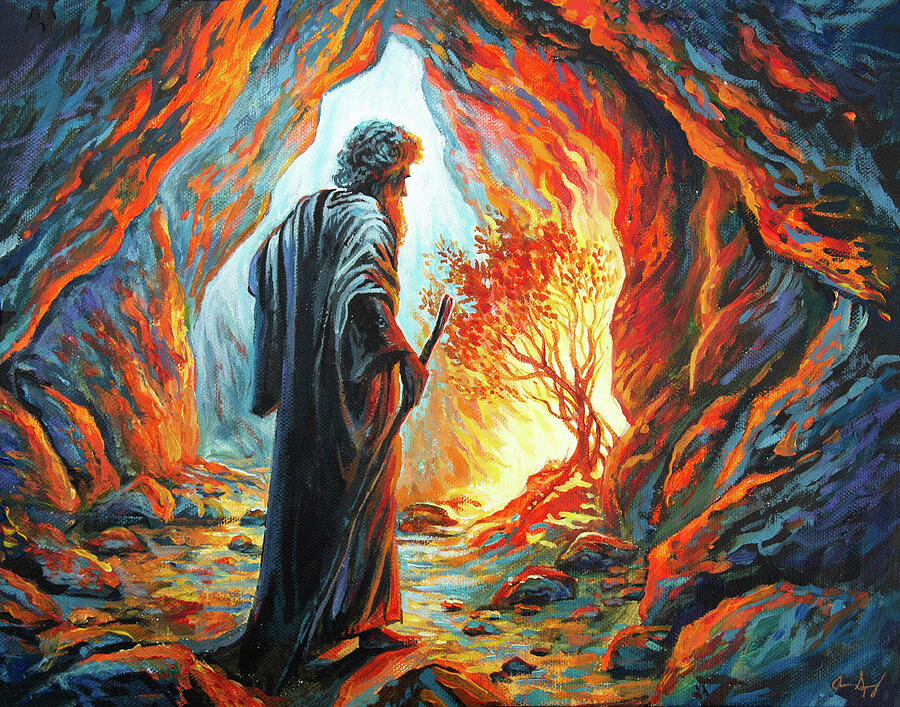
 

Do you think that I have come to give peace on earth? No, I tell you, but rather division. 


I’m guessing none of us have this section of Scripture for our confirmation verse or scrolled in beautiful calligraphy over our fire place. Maybe you even winced a little while saying, “This is the Gospel of the Lord.”


Jesus’ words in Luke 12 are challenging to hear. Hard to understand. Why is the Prince of Peace speaking about fire, baptism, peace, and division? 


Knowing what’s happening in Luke 12 and what Jesus says will give us a better grasp of this hard saying of Jesus, and help us better understand Jesus’ pyrotechnic preaching


Throughout Luke 12, Jesus addresses several groups of people: His disciples. The crowds. And the Pharisees. Jesus prepares his disciples for future persecutions; he warns the disciples and the crowds against the hypocrisy of the Pharisees; and he lovingly admonishes them not to trust in possessions. Fear not. Jesus’ death and resurrection is greater than all that life throws at you. God has you covered. He is faithful. He will preserve, protect, and deliver you. 


And then comes today’s reading: I came to cast fire on the earth, and would that it were already kindled! I have a baptism to be baptized with, and how great is my distress until it is accomplished!  


Even though his language sounds jarring, Jesus’ has been leading us and his disciples to this very point. Fire. Baptism. Peace. Division. These words encompass everything Jesus’ ministry is about. 


Fire, as we know well during wildfire season, is both destructive and purifying. Scripture uses fire both ways: as a sign of God’s judgment and wrath against sin. Fire is also refining, purifying, holy-making like when Jesus pours out the Holy Spirit and fire on Pentecost, the fiery wind of the Spirit. Gospel fire. Like the pillar of fire that led Israel through the Sea or the fire of the burning bush that did not burn up, the fire Jesus casts upon the earth is a refining, purifying, illuminating fire.


For Jesus is the one upon whom the fire of God’s wrath for sin has fallen. On the cross, God’s wrath is kindled, but not against us. On Jesus. We’re like Shadrach, Meshach, and Abednego, as Jesus is crucified in the fiery furnace of God’s wrath to save us. 


For fire to be kindled, there must be sacrifice, a whole burnt offering, a sinless Victim for the sinful many. For this peace that passes our understanding to come to us, there must be a death, and not just any death, but the death of God in the Flesh. He alone can kindle this fire. No amount of rubbing the sticks of our good works together can accomplish this, no matter how many merit badges we accumulate to our credit. 


Only Jesus can bring Pentecost fire to the earth, but first, He must die and rise. There is no other way than the way of the cross. And in the words of today’s Gospel, He is driven and compelled to the cross. 


And would that it were already kindled, Jesus says. Great is my distress until it is accomplished. Finished. Completed. 


Jesus is pointing us ahead to his crucifixion. His ministry begins and ends with Baptism. First his watery baptism in the Jordan. Then his bloody/fiery baptism on the cross as he atones for the sin of the world. The water of the Jordan that flowed over Jesus’ head gives way to the water and blood that flows out of Jesus’ side. From the cross. To the font. To the chalice. For you. 


This is what brings peace. In the darkness of Good Friday, the fire of God’s love burns brightest. The burning passion of God to save sinful humanity and a fallen creation. There, in Jesus’ death, is a peace that the world cannot give. A peace the world does not know. A peace the world hates. It’s the peace of sins washed away by the blood of the Lamb, the peace of good news and rescue…that for you, there is no condemnation for you in Christ Jesus.


This, then, is the irony and paradox of the Christian life. Receiving His peace. Baptized into Jesus’ death and resurrection. Purified and cleansed by his sacrifice on the cross….means that more often than not, we find ourselves at odds with the world. 


Do you think that I have come to give peace on earth? No, I tell you, but rather division. 


For many of us, Jesus’ words hit home. We live in a divided world. Simply confessing the Christian faith, and living in Christ, we’re divided from those who don’t. Some leave the church or reject our Lord. And then there’s our sins of thought, word, and deed that cause division in our families, marriages, friendships, and everything. This is why we call the church the family of God. Brothers and sisters in Christ. Bound together by the cross; the font; and the altar –the communion of saints.


Jesus was no stranger to division. That’s exactly what happened to him on the cross. Jesus…Forsaken for you. Judged for you. Crucified for you. Jesus was divided from the Father as he bore all our sins of division, so that in his death and resurrection you and I would never be divided from him. 


Therefore let us run with endurance the race that is set before us, looking to Jesus, the founder and perfecter of our faith, who for the joy that was set before him endured the cross, despising the shame, and is seated at the right hand of the throne of God. Consider him who endured from sinners such hostility against himself, so that you may not grow weary or fainthearted.


In the Name of the Father and of the + Son and of the Holy Spirit. Amen. 

Monday, August 4, 2025

Sermon for Pentecost 8: "Parable of the Rich Fool"


+ 8th Sunday after Pentecost – August 3rd, 2025 + 

Series C: Ecclesiastes 1:2 – 2:26; Colossians 3:1-11; Luke 12:13-21

Beautiful Savior Lutheran Church

Milton, WA


A Chorus of Voices: The Reception History of the Parables: Rembrandt and  the Parable of the Rich Fool of Luke 12:16-20 (Part 1)


In the Name of the Father and of the + Son and of the Holy Spirit. Amen.


C.S. Lewis opens his famous Narnia book, The Voyage of the Dawn Treader by telling us…“There once was a boy named Eustace Scrubb and he almost deserved the name.” As the story moves along, you see why Lewis said this about Eustace. He’s arrogant. Selfish. Self-righteous. As the story progresses, Eustace wanders off alone and finds himself (though unbeknownst to him) in a dragon’s lair surrounded by the dragon’s hoard. He’s giddy and greedy. A deadly synthesis. 


When morning comes he wakes up only to discover that he has become the dragon. Eustace has fallen ill with what the old tales call dragon-sickness. The love of gold…of possessions…and stuff.


Dragon-sickness isn’t just in fairy tales though. You’ll find it in the true story of the Scriptures too. An unknown man in the crowd comes up to Jesus and says, “Teacher, tell my brother to divide the inheritance with me.”


It doesn’t take a family therapist to realize this isn’t an idyllic episode of “Leave it to Beaver.” The father has died, leaving no oral or written will. The brothers are bickering over who gets dear-old-dad’s estate. It’s divisive and ugly. And Jesus knows it, and wants no part in it. “Man, who made me a judge or arbitrator over you?”


The problem isn’t that this man seeks out Jesus, but that he comes to Jesus searching for the kind of justice that Jesus did not come to bring. Justice comes when Jesus justifies sinners by his death for you. Jesus didn’t take on human flesh to take on inheritance disputes, but to take on your sin and be your Savior. This fellow wants Jesus to divide the inheritance between him and his brother, while Jesus comes to reconcile sinners, rescue you from idolatry, and rob the grave of swallowing you and I in our desires. 


Jesus gives the antidote to dragon-sickness. His prescription comes to you in a story. He starts this way. “Take care, and be on your guard against all covetousness, for one's life does not consist in the abundance of his possessions.” 


One’s life – body and soul, Jesus says, does not depend upon, consist of, or rest upon gold, galleons, or loads of stuff…but on grace on gift from God’s hands to your life. This man in the parable falls into the dragon’s lair, thinking everything he has – possessions, wealth, land, abundant crops, barns bursting at the rafters with produce –was all his due…what he deserved, when in fact it’s all gift. 


Same is true for you. Everything you have, is as an old radio host once said, talent on loan from God. All you and I have from the soles of your shoes and sandals to the top of your head, everything below and above and around you, everything in your home, closet, driveway, garage, and bank accounts. It’s all gift from your good and gracious Heavenly Father. 


This story is called the parable of the rich fool not because this man is rich…anyone can be a fool no matter what’s in your wallet. He’s a fool because he’s self-righteousness. He trusts in his riches, and not the righteousness that comes as free gift in God’s steadfast love. He is a fool because he has the wrong god.


‘What shall I do, for I have nowhere to store my crops?’ 18 And he said, ‘I will do this: I will tear down my barns and build larger ones, and there I will store all my grain and my goods. 19 And I will say to my soul, “Soul, you have ample goods laid up for many years; relax, eat, drink, be merry.”’


This is what sin and greed does…it’s myopic. It curves you and I in on ourselves…just like this fellow. Everything is               “I”       “I”            “I“       “My”   “My”   “My”. It’s exhausting.


Reminds something the great hymn-writer, Johnny Cash, once sang: 

How many times have…You heard someone say…If I had his money…I could do things my way

But little they know…That it's so hard to find…One rich man in ten…With a satisfied mind


The rich fool is like Eustace Scrubb. He’s down with the dragon-sickness. And if all that’s not dark enough, this rich fool is utterly alone. He has no family, no friends, no community to share his stuff with…so he talks to himself. This is what the devil and your sinful flesh won’t point out on the warning labels of your sinful desires: idolatry is terribly isolating and sin leaves you utterly alone. 


 So is the one who lays up treasure for himself and is not rich toward God.”


This part of the story is terrifying. Jesus’ story reveals that there’s a rich fool within you and in me, that is always desiring what is best for I, I I, and what’s mine , mine, mine. It’s the ugly truth, but you and I are idol-hoarders. You and I are like this rich fool, possessed by our possessions, rather than holding them in the open, dead-hand of faith. We’re deadly ill with dragon-sickness.


For Eustace and for the rich fool, and for you and I, there is only one cure. It’s not selling everything you have. It’s not even using the good things you have with enjoyment and thankfulness and for your neighbor – that’s the fruit and it’s good. 


But the cure is death. For Eustace, in that story, Aslan the Lion came along and tore his scaly, dragon, hide right off of him, dunked him in a pool, washed him, clothed him, and he was a new boy. Dead and alive again.


So it is for you. Your life does not consist of your possessions, but in Christ who possesses you by his passion to save. Jesus has un-dragoned you in the pool of water we call a baptismal font. Jesus, the Lion of Judah dunks you in the water, drowns your sin -along with all its desires, greed, and idols – and washes you clean, robes you in his holiness and righteousness, calls you his own. He treasures and cherishes you, lavishes his grace and goodness and gifts of body and soul upon you. Not just once. Not just a little bit. But daily. Abundantly. More than you ask for. More than you deserve. Grace upon grace upon grace. 


You are free. Free to thank God for whatever he’s given you, be it little or much. Free to be content in our Lord’s gifts of daily bread. Free to enjoy God’s gifts of daily bread. Free to hold them in the loose, dead hand of faith. Free to use God’s gifts in love and service of your neighbor. 


You were dead. But now you are alive. You were dragon-sick, but now you are holy in Jesus. Your life isn’t found in your insatiable desires, but in the incredible, all-sufficient grace of Jesus crucified and risen for you. This is what it means to be rich towards God. To know that you are his treasure. That all you have is a gift. And that today he comes bearing even more gifts. Holy treasures hidden in humble things: water that drowns your sins. words that raise you from the dead. Body and blood in bread and wine that strengthen you against the dragon’s breath by a promise: you are forgiven all your sins.


In the Name of the Father and of the + Son and of the Holy Spirit. Amen. 

Monday, July 21, 2025

Sermon for Pentecost 6: "Holy Hospitality"

 + 6th Sunday after Pentecost – July 20th, 2025 +

Series C: Genesis 18:1-14; Colossians 1:21-29; Luke 10:38-42

Beautiful Savior Lutheran Church

Milton, WA


In the Name of the Father and of the + Son and of the Holy Spirit. Amen.
 

Don’t just do something, sit there! 


No, that’s wasn’t a slip of the tongue. You heard that right. Don’t just do something, sit there.


You and I are used to hearing, perhaps even saying, the opposite… “There’s no time for lollygagging, dillydalling, or thumb-twiddling. Get off your duff. Don’t just sit there, do something.”


But then along comes Jesus. Martha invites him into her home. Mary and Martha are both good friends. Beloved disciples. And sinners and saints like you and I. Jesus enters as a welcomed guest, but honestly, he’s really the Host, the Divine Visitor. Jesus comes as the Holy Hospitality Worker serving up a gracious surprise for Mary and Martha and you. Jesus throws all our plans out the window. “Don’t just do something. Sit there. Rest. Receive. Rejoice.”


For when Jesus comes, he comes as a gracious host full of good news for Mary and Martha and for you. Jesus is the Son of Man who came not to be served but to serve and to give his life as a ransom for many. When Jesus shows up, he brings with him a holy hospitality.


Just ask Abraham and Sarah. When the Lord, the Malak YHWH, the Angel of the Lord, Jesus before his incarnation, pays them a visit under the oaks of Mamre, he comes bearing gifts. Yes, Abraham prepares the BBQ. Sarah prepares some cakes of grain. But YHWH delivers the main course. A promise. “Don’t just do something, sit there and watch me do what sounds impossible and too good to be true, but it is…By this time next year, you’ll be changing diapers on a little bundle of joy.” And a year later, YHWH delivered on his promise and Sara delivered a son. Isaac – laughter – was born.


Is anything too hard for YHWH? Not at all. Don’t just do something. Sit there. “If you thought that was wild, just wait and see what I’m going to do when I send my own promised Son from the family tree of Abraham’s son…to a Virgin named Mary.”


When YHWHW takes on human flesh, he does for you what he did for Abraham and Sarah. He comes with holy hospitality to serve and save and sanctify you. This is what Jesus, the Divine Visitor does when he steps into the home of Martha and Mary. “I come with holy hospitality, to satisfy your anxiousness by my presence and word. To fill your emptiness with the bread of life. To bear you burdens. To serve you by my sacrifice. To clear away all your distractions and give you with my divine, steadfast love. I give you the good portion of my grace and goodness that will never fade away.”


Luke draws our attention first to Mary. Mary, we are told is sitting at Jesus’ feet, listening to his teaching. This is the posture of the disciple in the Scriptures. At the feet. Hearing the Word. Continually. Ongoing. 


Then, Luke shifts the camera around to Martha. She’s a gracious hostess. Welcomes the Rabbi. Prepares the food. Pours the wine. Shows hospitality. She serves (literally diakonia). But there’s a problem. Well, two problems really.


Martha brings the first problem to Jesus’ attention. “Lord, do you not care that my sister has left me to serve alone? Tell her then to help me.” 


Seems like a reasonable request, especially to any of you who have worked hard or grown weary serving others, and we’ve all been there. “Come on, Mary, don’t just sit there, do something!”


And this is where Luke reveals the second problem. Martha is distracted (overburdened, feeling dragged or pulled around) by much serving. Pay close attention to the words used here. The problem isn’t Martha’s service (her diakonia). That’s a good thing. A holy thing. Jesus doesn’t rebuke her loving service and hospitality, but he does remove her distractions. So that he can give her what is most needful…his word. His life. His teaching. His good news. His gracious promises. 


Martha isn’t alone in her distractions. You and I are right there with her. Daily life overwhelms you in a Jenga tower of distraction upon distraction. Always looking to distract from the pain or the joy or the sorrow or the silence. Your sinful flesh is like Labrador, always chasing the next squirrel. Breaking news alerts. Scrolling phones. Checking emails. Notifications. Texts. Wifi. Radio. It’s not that these are all bad things…much of it can be good, but never at the expense of God’s Word. 


Distraction has been Satan’s greatest tool against the Word of God since the beginning. Is the fruit good for eating? Is it desirable for making one wise? The ancient dragon is an expert distractor. Even distracting us with good things in order to keep us away from the Word of Life. But there’s one man he cannot distract or deter or defeat. The Son of Man. 


Remember, Jesus loves Mary and Martha. Jesus comes to their home as Rabbi, Teacher, but also their friend, the friend of sinners, and as the Gracious Host full of divine hospitality for them and for you. 


“Martha, Martha, you are anxious and troubled about many things, but one thing is necessary.  Mary has chosen the good portion, which will not be taken away from her.”


In other words, Jesus tells Martha… “There is time for serving. But now is the time for hearing. To serve the Lord you must first be served by me. So, don’t just do something, sit there.  Rest. Receive. Rejoice in my holy hospitality for you.”


Jesus is gentle in his reply to Martha. He doesn’t rebuke her service, but he does seek to calm her anxious heart with his holy word, same is true for you. Jesus comes to make your burdens his own. To clear all your distractions and deliver you his divine goodness and grace. Jesus leads you, as he did Mary and Martha, to the good portion of his Word, his life, his steadfast love.


You and I are a lot like Mary and Martha, sinners and saints, visited by the holy hospitality of Jesus. Jesus cares for Mary and Martha. Visits them in their home with his presence. Fills their ears with his teaching and proclamation of good news. Brings Mary and Martha true rest in his rescue. 


So it is for you. “Here in my house, where I am host and guest, I care for you. I visit you in my word and supper. I fill your ears with my teaching and proclaim to you, I forgive you all your sins. I bring you rest in my redemption. I bring you life from the dead. I give you the good portion, my promises as you hear, listen, sing, pray, meditate, kneel. Here I am serving you. forgiving you. blessing you. I am your gracious host and today I come bearing gifts.”


And today, Jesus, your Holy Hospitality Worker has prepared everything for you. The table is set.

So, don’t just do something. Sit here. Rest. Receive. Rejoice.


In the Name of the Father and of the + Son and of the Holy Spirit. Amen.

Monday, July 14, 2025

Sermon for Pentecost 5: "Jesus the Good Samaritan"

 + 5th Sunday after Pentecost – July 13th, 2025 +

Series C: Leviticus 19-9-18; Colossians 1:1-14; Luke 10:25-37

Beautiful Savior Lutheran Church

Milton, WA


In the Name of the Father and of the + Son and of the Holy Spirit. Amen.


Whenever you watch a movie or read a story a little game begins in your imagination. You imagine yourself in the story. You see Sherlock Holmes and imagine yourself as a clever, witty detective hunting down the villain. You see Superman and picture yourself leaping tall buildings with a single bound to rescue the child from certain danger. You and I picture ourselves, indeed we long to be, the hero or heroine of the story, the good guy, the Oscar winner for best actor/actress.


Jesus’ parables are no different. When you hear Jesus tell the story of the Good Samaritan – one of his most famous and familiar stories - who do you imagine yourself to be? Well, I sure don’t want to be that priest and Levite, unwilling to get their hands dirty and bloody and ritually unclean. And no one wants to be a bloodied and bruised, half-dead mess of a guy in the ditch. So, your answer is probably the same as mine; it’s gotta be…the Samaritan. 


And it’s tempting…easy even…to cast ourselves in the lead role of this parable. To put ourselves in the spotlight at center stage of this story and come out with a great moral lesson on helping others and being a neighbor to others around you – whoever that may be. And there is a place for you and I in this story…but it has to be as understudies, not the lead role. Jesus does instruct you and I to “Go and do likewise”, to be the compassionate neighbor you are in Him. But this comes only after Jesus is the neighbor to you. Only after Jesus has completely destroyed all our attempts to justify ourselves, and bound up our wounds, charging everything to his account, and places us in his holy inn.


You see, Jesus, the director, writer and producer of this divine drama, has the lead role of this parable set aside for someone else…and I’ll give you a hint, it’s not the lawyer; it’s not me; and it’s not you. It’s Jesus. He’s the Good Samaritan for you. But we’re getting ahead of the story.


Remember that this whole story begins with a conversation – really, an interrogation, a testing, a cross-examination. A lawyer, a teacher of the Law of Moses comes up to Jesus and asks him, “What must I do to inherit eternal life?” Jesus answers his law question with a law-answer. What is written in the Law? The Torah. The books of Moses. The lawyer answers correctly. Love God. Love your neighbor. Do this and live. 


But the lawyer pressed his case. Luke gives us an insight into the lawyer and this story. Desiring to justify himself, he said to Jesus, “And who is my neighbor?”

This is how the old Adam – your sinful flesh and mine – thinks. That God’s Law is doable. Achievable. Manageable. That it’s like a checklist you can mark off as you go. Well, I haven’t murdered anyone today. I haven’t looted any Nike stores this week. And who is my neighbor anyway? I’ll help that person out and mark them off my list too. You and I treat God’s Law like the tax code, always looking for loopholes and exemptions. That’s good for taxes, not so good for theology.


So, Jesus answers the lawyer not with a dictionary or a DIY list, but with a story. 


There was a man who fell among thieves on the road from Jerusalem to Jericho. Jesus knew this road well; it was known as the Way of Blood. A popular pilgrim highway ripe for robbers and thugs. The man is stripped, beaten, and left for dead on the roadside.

Three travelers come across the man. The first, a priest, passed by on the opposite side of the road. No sense becoming ritually unclean by touching a dead body. Hard to do priestly things if you’re ritually unclean. Wouldn’t be safe or prudent or pure. 


Along comes a Levite, a priestly assistant. Second verse same as the first. He passes by the man. Finally a third man comes along. Jesus’ hearers would’ve expected someone like a Jewish layman to be next. Priest. Levite. Layman. But no. There’s a shocking, scandalous surprise. 


The third man stops. He’s filled with a gut-wrenching compassion. He jumps down into the ditch. Cleans the man’s wounds. bandages. First aid. Oil and wine. Sets him on his own donkey. Travels to a local village, where he’s probably hated and considered an outsider by everyone in town, pays for the man’s room and board, and tells the innkeeper to charge any additional costs to his account. 


And who was this kind stranger? We call him the good Samaritan. But this word doesn’t hit our ears the same way it would’ve hit Jesus’ hearers in the 1st century. We hear Samaritan and think Good Sam Hospital or being a Good Samaritan. But in Jesus’ day, Samaritans were good for nothing. Half-breed heretics. The lowest of the low. Samaria was a place of outlaws and fugitives and idol worshippers.


We come back to the question…who are you and I in this story? Are you the nearly-dead man in the ditch? Or are you the lawyer and the priest and the Levite? The answer is yes. You and I are both the lawyer and priest and Levite – always looking to justify ourselves, and you and I are the nameless, lifeless half-dead, bloody, broken man in the ditch. There’s a little lawyer in each of us…who loves to stand in the courtroom with all the cameras on and argue your own case and present all the evidence. “At least I’m not as bad as others.” Deep down I’m really a good person. Truth is, there’s no end to the ways you and I attempt to justify ourselves. 


But you and I are also the man left for dead along the roadside. Broken by sin. Dead in trespasses. Wounded. Weary. Bruised and beaten by the world. Bloodied and left for dead by griefs. Sorrows. Aches and pains. Chronic diseases and cancers. Broken families. Broken bodies. Broken lives. 


Your story needs a hero. You need the Good Samaritan. One who has born your griefs and carried your sorrows. One whose wounds heal you and words give you life. Where you and I keep a check-list of our greatest and worst accomplishments, Jesus holds no records of wrongs and cancels your debt. Where you and I fail to love God and our neighbor, Jesus loves you with a perfect, sacrificial love.


Jesus is the Good Samaritan who travels the Way of Blood all the way to the cross for you. He pours out his gut-wrenching compassion to justify sinners. He is despised and rejected for you. He jumps down into the ditch and gets his hands and feet and whole body down in the mud and the blood and the uncleanness your brokenness and sin for you. He binds your wounds and heals you with his own. He charges every one of your expenses and debts to his own account. 


Jesus, the Good Samaritan, is also the one who also brings you and keeps you safe in the sacred inn of his holy Church. Here, He gives you food and drink and fellowship. A safe haven. A place of rest and restoration in the blood of Jesus. A place where you are given to bear one another’s burdens. A place where weary, broken sinners are also blessed to be innkeepers and stewards of the Good Samaritan’s gracious gifts. 


And as you travel the road of this life, Jesus is your Good Samaritan, and in him, you are good Samaritans too. Your life and faith and story are safe in the wounded, crucified and risen hands of Jesus your Good Samaritan.


In the Name of the Father and of the + Son and of the Holy Spirit. Amen.

Monday, July 7, 2025

Sermon for Pentecost 4: "Thy Kingdom Come"

 + 4th Sunday after Pentecost – July 6th, 2025 +

Series C: Isaiah 66:10-14; Galatians 6:1-18; Luke 10:1-20

Beautiful Savior Lutheran Church

Milton, WA


The sending of the 72 in Luke 10 | Psephizo


In the Name of the Father and of the + Son and of the Holy Spirit. Amen.


Whenever you enter a town and they receive you, eat what is set before you. 9 Heal the sick in it and say to them, ‘The kingdom of God has come near to you.’ 


Jesus says these words to his disciples as he sends them out – literally chucks them out like fish at Pike’s Place market. Jesus’ words are the church in an acorn shell. Everything he gives his disciples to do he gives his you, his bride, the church to do as well. 


So, there’s food and fellowship. A table and teaching where Jesus dwells with and for sinners. Healing and peace. Preaching and promise. All in the name of Jesus. All by the grace of Jesus. This is how Jesus rules…not with a show of force, but by sins forgiven. Not in the ways we would think: God reveals his glory and power and kingdom in hidden, ordinary, seemingly weak and lowly ways and words…words and actions which are at the same time creative, sufficient, and for you.


Jesus is the King after all, and he is good. And so is his reign. His rule is peace for rebels. Healing for the broken. Rest for the weary. Calm for the anxious. Hope for the despairing. Honor for the shamed. Pardon for the guilty. Life for the dead. Outrageous forgiveness for undeserving sinners. A King who is crucified and risen all so that he can bring you into his kingdom.


But what exactly is the kingdom of God? Jesus says it quite a bit. Preaches about it all over Judea and Galilee. Sends his disciples out to preach the good news that “the kingdom of God has come near to you.” We hear it and sing it; we even pray it – “Thy Kingdom Come”. But what does that mean? What does this kingdom and rule and reign of Jesus look like? Where is it found?


In the Old Testament the kingdom of God is seen in God’s creating life out nothing: a whole cosmos, creatures and all creation simply by saying the words: “Let there be…” The kingdom of God is seen in God sharing his rule and reign with Adam and Eve as they work the garden.


The kingdom of God is seen in the ark, that flagship of YHWH’s salvation navy, that delivers Noah and his family out of the old and into a new creation. Or in the dove that YHWH sends bearing good news of an olive branch in its beak.


The kingdom of God is seen when YHWH makes a promise to Abraham and Sarah that’s so wild she laughs out of joy and later calls this promised son, Isaac (laughter). 


The kingdom of God is seen in a tiny, woven basket, floating down the Nile River out of the wreckage of Pharaoh’s slaughter of the young Hebrew boys. And then through the waters of the Red Sea. And later the Jordan.


The same river…not coincidentally, many years later…where the Son of God in the flesh steps into and the Father speaks that this is his beloved Son with whom he is well pleased. And through whom he is well pleased with you too. Where the Spirit descends in the form of a dove to bring rest and peace and shine his holy spotlight on the King and the coming Kingdom there in the water.


And so the kingdom of God is seen in the New Testament too. In Peter making a fool of himself yet later restored by Jesus.


You see the kingdom of God in a sycamore tree where Jesus tells Zaccheus, “Zacchaeus, hurry and come down, for I must stay at your house today.”… “Today salvation has come to this house, since he also is a son of Abraham.10 For the Son of Man came to seek and to save the lost.”


You see the kingdom of God when Jesus heals the sick, makes the lame walk, raises the dead, feeds the hungry, and washes his disciples unclean, filthy feet. When the Lord of all becomes the servant of all. When the Rabbi reveals that he is also the Redeemer. That the Holy One of Israel comes in great humility to save you. That the King prefers to wear a crown of thorns to bring you into his kingdom. 


There on the cross, that’s where you see your King and his kingdom most clearly. That is where everything he says, everything he does, every sermon, teaching, and conversation points to. To miss this leads only to sadness and rejection. Not because he rejects you. No he doesn’t work that way. But because you will have chosen your kingdom over his. That’s the thing about this King and Kingdom. You don’t come to him; he comes to you. You don’t find the kingdom, the kingdom finds you. You don’t deliver yourself; your King delivers you. 


This is why Jesus teaches his disciples that, “Whatever house you enter, first say, ‘Peace be to this house!’” Peace… because you and I are a mess of broken, weary, wild, wicked sinners. Our sinful flesh is kaleidoscope of transgressions spinning in rebellion against the King. Our lives are spent living in a world of hurt, sorrow, suffering, pain, and despair. One gut-punch after another. You and I are bruised reeds. Fainting wicks. Sinners in need of forgiveness. The sick in need of the Physician. Traitors in need of a true and good and gracious King.


So what does King Jesus do? He quells our rebellion with his own blood. He makes peace for you by his pain and agony. He brings you healing by being humbled unto death on the cross. King Jesus rules and reigns and brings his kingdom to you in humble, hidden, yet holy ways and words.


What does the Kingdom of God look like? Where is your King found? Right where he promises to be for you. The kingdom of God comes to you in a flood of forgiveness. In the font where the Spirit-dove brings you something better than an olive branch. He brings you Jesus, the righteous branch who died on the tree to save you. And he plops you in the ark and ferries you over the raging waters.


The kingdom of God comes to you in words spoken by a sinner to fellows sinners, a word that opens heaven for you, sets you free from sin, and makes you whole and holy in Jesus. The same Jesus who said “Let there be light” in creation, now says “Let there be forgiveness” and makes you a new creation.


The kingdom of God comes to you, as it did for Jesus’ disciples: at the table and in the teaching. Supper and Scriptures. Body and blood and promise. Given and shed for you. the kingdom of God comes to you in humble, yet holy words that give you what Jesus promises: peace, healing, life.


But there’s more. Jesus not only gives you his kingdom, he sends you out to proclaim his good and gracious rule. 


So you see the kingdom of God when you pray with your neighbor who just got off the phone with their oncologist and the news isn’t good. You see it when you offer a word of hope to someone who’s despairing: Jesus died for that too. He is for you. You see it as you bear one another’s burdens, Paul says. You see it as you tell your friends and neighbors, come and see. Come to our Lord’s house. For The kingdom of God has come near to you.’ Jesus, the King, is here with all his peace, pardon, and promise for you.


In the Name of the Father and of the + Son and of the Holy Spirit. Amen.