Monday, October 6, 2025

Sermon for Pentecost 17: "How Long?"

 + 17th Sunday after Pentecost – October 5th, 2025 +

Series C: Habakkuk 1:1-4, 2:1-4; 2 Timothy 1:1-14; Luke 17:1-10

Beautiful Savior Lutheran Church

Milton, WA


How Long, Oh Lord? | Pastors' Blog


In the Name of the Father and of the + Son and of the Holy Spirit. Amen.


O Lord, how long shall I cry for help, and you will not hear?

The prophet Habakkuk begins his book with a prayer that echoes throughout the Scriptures. 


It’s not hard to imagine Adam and Eve praying this prayer, wondering when that promised Seed and Son would be born. How long, O Lord?


I’m sure sometime during those 40 days and 40 nights of torrential rains and divine deluge Noah prayed something like this. How long, O Lord?


In his seemingly endless suffering, Job prayed, “How long will you torment me and break me in pieces with words?”


In anguish and surrounded by enemies, David prayed, How long, O Lord? Will you forget me forever?     How long will you hide your face from me?


In the midst of Israel love affair with false idols, surrounded by the faithless, Jeremiah lamented, How long will the land mourn and the grass of every field wither? How long?


God’s prophet Habakkuk, faced with the injustice and unrighteousness and wickedness of Judah also carried the tune of this ancient lament before the ears of God. O Lord, how long shall I cry for help,
    and you will not hear?

Habakkuk wrote these words long ago in the 7th century B.C. as Judah as threatened by Babylon without and injustice and evil within. But honestly, he could just as easily have written them today in the 21st century. The wicked seem to prosper. God’s people suffer. Justice is perverted, if there’s any justice at all. The violence and malice of this fallen world seem to win the day along with every headline. Sin and evil and hate seem to be running amuck, like a free-range child let loose on a playground without no supervision in sight. Iniquity appears to go unchecked, unpunished, unhinged. 


And so we pray the prayer that Habakkuk, and so many have prayed before.


How long, O Lord?


It’s a short prayer. But I imagine for most of us, it’s a familiar prayer. How long, O Lord?

When exhausting days turn into sleepless nights. When your calendar is full of more doctors’ appointments than adventures. When you find yourself waiting for a voicemail from the doctor about a diagnosis, or lab work, or what kind of treatment is next. When the only time you see family and friends is at an ever growing list of funerals. You find yourself praying this prayer.


How long, O Lord?

Some think it’s impolite or impious to pray this way. They’re wrong. It’s not. This prayer is a cry for help. For rescue. For God’s righteousness. For things to be made right. For brokeneness to be healed. For wickedness to be thwarted. For grace and mercy to win the day.


Some think it’s a lack of faith that gives rise to prayers like this. It’s not. This is a prayer of faith cried out to the only one who can actually in his time and by his grace answer that prayer. 


So whenever you find yourself praying this prayer, know that you’re in good company. Habakkuk, David, Jeremiah. Prophets. Patriarchs. Even Jesus himself prays something similar in Gethsemane: Father if it be your will, take this cup from me. Nevertheless, not my will but yours be done.


Also know this…when this is the only prayer your weak voice can utter. When it’s prayed in anger or pain. Despair or fear. Whether you’re sobbing or all out of tears. Bring this prayer before God. In fact, he invites it. Why else would he put it in Scripture for us, other than to give voice to our prayers and cries of lament.


When you have a complaint, and we all have them at some point, who better to bring that complaint to than God. Lord, to whom shall we go? You have the words of eternal life, even when all of our words and life are nothing but grumbling and complaining. Complain to God. He can handle it. His grace is sufficient for you, especially when you are weak and it seems as if all is lost. 


Whether it’s this wicked world you lament, or your own sin and folly, or the hurt and pain caused by others. Join Habakkuk in praying, How long, O Lord?


After all, these words do not fall on deaf ears, but on the ears of him who promises to hear. Remember. And answer. 


Habakkuk’s book begins with a complaint to God. But ends with comforted by God. 


Though the fig tree should not blossom,
    nor fruit be on the vines,
the produce of the olive fail
    and the fields yield no food,
the flock be cut off from the fold
    and there be no herd in the stalls,
yet I will rejoice in the Lord;
    I will take joy in the God of my salvation.


Habakkuk rejoiced, even in his suffering, in the one who came to suffer with us. For us. 


Jesus’ “How long?” of Thursday night and Good Friday was answered quickly. 3 days. That’s how long. Cross. Suffering. Death. Burial. Tomb. But then…resurrection. Joy. Life. Light.


We’re not always told how long we’ll pray our “How long?” prayers before they’re answered. But, you can rest assured – with Habakkuk and all who have prayed this prayer before – that God will answer. And when he does answer, it’s always the same answer. Jesus. 


So lay your complaints at the foot of his cross. Cry out your laments; he is full of steadfast love. And know that whenever you pray, “How long, O Lord?”, he will answer. My grace is sufficient for you.


In the Name of the Father and of the + Son and of the Holy Spirit. Amen.


Monday, September 29, 2025

Sermon for St. Michael and All Angels: "Christ's Warrior-Poets"

 + St. Michael and All Angels – September 28th, 2025

Daniel 10:10-14, 12:1-3; Revelation 12:7-12; Luke 10:17-20

Beautiful Savior Lutheran Church

Milton, WA


Sermon: St Michael and All Angels 2023 – Concordia Lutheran Theological  Seminary


In the Name of the Father and of the + Son and of the Holy Spirit. Amen.


When God gave Moses the holy blueprints for the ark of the covenant in the Most Holy Place, he was told to make a covering of gold. The mercy seat. A place for blood. For atonement. For YHWH dwell with and for his people. And God’s sacred seat, or throne, was adorned with gilded cherubim. 


When God gave Isaiah a vision of his heavenly throne, there too, YHWH was seated, surrounded by seraphim crying out, “Holy, holy, holy is the Lord of hosts.


Since their creation, wherever you find the angels – or better yet…where they find you -  they’re surrounding our Savior and telling the story of salvation. And wherever you find Christ at work – from Genesis to Revelation – you’ll find the Lord of Sabaoth commanding his army of holy angels. They’re his ministers. Messengers. And Heralds. Guardians. Defenders. And Protectors. Servants. Singers. Storytellers and Soldiers. 


Today we remember and give thanks to God for St Michael’s and All Angels. Christ’s holy angels are warrior-poets, armed to the teeth with God’s word, shielded by the blood of the Lamb, and wielding the sword of the Spirit. They’re Christ’s sacred storytellers and holy Spartans of heaven. Sent to declare and defend Christ’s victory…the deliver story of salvation.


Today we also remember that while angels are many things in Scripture, marvelous spiritual beings, , one thing’s certain. They’re not cute, cuddly, or chubby. They’re holy. Mysterious. Awesome – in the old meaning of the word. There’s a reason their first words are often, “do not fear.” 


And as St. John learns in Revelation, we don’t worship the angels. We worship with them. And they worship with us. Together we bow before Christ. We don’t pray to angels either. We pray with them. They pray with us. Together calling upon Christ. Praising Christ. Pointing to Christ. Protecting you who are in Christ. Proclaiming Christ for you.


For those are their holy marching orders. They’re ministers of God’s mercy. Preachers of Christ’s promises. Messengers of the Messiah. Defenders of Jesus’ disciples. Servants of the Savior for his saints. It’s like the old tales where the king leads his men into the fray. Steps into the breach ahead of his troops. Christ is first over the trench wall. 


Wherever Christ goes for our salvation, his holy angels go with him. When Gabriel announced the coming birth of Jesus to the Virgin Mary, Christ’s holy angel sounded his arrival. “behold, you will conceive in your womb and bear a son, and you shall call his name Jesus.”


When Christ’s birth was announced to lowly shepherds, his holy heralds lit up the sky and filled the air with a battle cry: “Glory to God in the highest, and on earth, peace, goodwill to men…for unto you is born this day in the city of David a Savior, which is Christ the Lord.”


When Christ was in the wilderness, weak from fasting, weary from temptation, having withstood Satan’s wiles, his holy angels ministered to him. 


When Christ prayed in Gethsemane, drops of blood gathering with his anguish and prayers, “Father, not my will but yours be done,” his holy angels were there again, strengthening for the blood and thorns and nails of the tree.


When the women came to Christ’s tomb that first day of the week. In the early dawn. Morning was breaking. But the seal of the tomb had already broken. And along with it, good news of great joy, delivered, once again by Christ’s holy angels. “Do not be afraid. You seek Jesus of Nazareth, the crucified one. He has risen; he is not here. See the place where they laid him.”


Whenever the Scriptures speak of angels you’ll find them surrounding Christ our Savior and proclaiming the story of salvation. For angels are not only servants and ministers and messengers of Christ. They’re also his servants, ministers, messengers, guardians, and defenders sent for you and for me and for all the saints. Though you may never see them this side of the new creation, rest assured, He shall give His angels charge over you, To keep you in all your ways.


Christ’s holy angels rejoice in heaven when you and I, or any sinner, live in that daily spiritual battlefield we call the baptized life of repentance and forgiveness. 


Christ sends his holy angels, his ministering spirits, to render service for your sake, for you who inherit salvation. For you are his holy ones, his little children of faith, held in arms of our merciful, heavenly Father.


Christ sends his holy angels to you guard you morning, afternoon, evening and night as you pray, “Let your holy angels be with me that the evil foe may have no power over me.”


Christ sends his holy angels to fight alongside you, for the ancient dragon, having lost the war in heaven, brings his fight to earth. For he knows his time is ticking…ticking…ticking. St. Michael and Christ’s holy angels conquered him by the blood of the Lamb and the word of Christ as their weapon. 


To be sure, this fallen angel tries to live up to his name, Satan…accuser. “Look what they’ve done. Said. Thought. They’re guilty…every one of them deserves death.” But he is as Jesus says: a liar. A con artist. A fallen angel. Wherever Christ is, his angelic warrior-poets are sitting in the foxhole with you. Wielding the same weapons you do: the blood of the Lamb and the word of Christ.


In life Christ sends his holy angels as our guardians and protectors. In death, his holy angels serve as our pall bearers, accompanying our souls to Christ until the Day of the resurrection of all flesh.


Until that day, Christ still sends his holy angels to us. Unseen yet present. Invisible yet active. Christ is still enthroned between the cherubim, here on the altar in bread and wine. Christ is still surrounded by seraphim as he sends you holy coals from his altar and puts them on your lips.


Today, we sing with St. Michael and angels and archangels and all the company of heaven as Christ, the Lord of hosts, gathers us to his table, and we join them in singing the ancient song, “Holy, Holy, Holy is the Lord of Sabaoth. Heaven and earth are full of your glory.” And today, so is his house and his people.


Today, we stand shoulder to shoulder with cherubim and seraphim, hearing and proclaiming the great story of salvation: Christ has died. Christ is risen. Christ will come again.


A blessed feast of St. Michael and All Angels, to each of you…


In the Name of the Father and of the + Son and of the Holy Spirit. Amen.

Monday, September 22, 2025

Sermon for St. Matthew's Day: "Riches to Rags to Riches"

  + Feast of St. Matthew, Apostle and Evangelist – September 21st, 2025 +

Ezekiel 2:8-3:11; Ephesians 4:7-16; Matthew 9:9-13

Beautiful Savior Lutheran Church

Milton, WA


Jesus Calling Matthew the Tax Collector : r/Christendom


In the Name of the Father and of the + Son and of the Holy Spirit. Amen.


There’s a common pattern in some of our favorite stories. You see it when… Cinderella goes from sweeping the ash heap to dancing with the prince at the royal ball. Charlie Bucket goes from living in poverty to running Wonka’s famous chocolate factory. Or Harry Potter goes from living in squalor in a cupboard, under a staircase at #3 privet drive to being a famous wizard.


We love these kinds of stories. The character is at a loss. Lowly. The least. Lacking something. And then something or someone – like a glass slipper, a golden ticket, or an owl comes along, and everything changes. From rags to riches.


You may not have realized it, but the story of St. Matthew is this kind of story. Except it’s a true story. And unlike most rags to riches stories in the history of the world, this one isn’t about starting a computer company out of a garage with some wit and grit, or building a steel empire out of elbow grease and ingenuity. 


No. Matthew’s story is the opposite. He’s is not the hero of his own story. He doesn’t pull himself up by his sandal-straps. He doesn’t go from rags to riches on his own self-righteousness. 


The change in Matthew. His repentance. Righteousness. Restoration. Faith, hope, and love. His life as a disciple, apostle, and evangelist did not come from within. It wasn’t found in his stacks of coins piled up in his tax booth. It all came from Jesus. By his word. Promise. And calling.

As Jesus passed on from there, he saw a man called Matthew sitting at the tax booth, and he said to him, “Follow me.” And he rose and followed him.

Matthew goes from tax collector to a disciple under the cross. 

Matthew goes from avarice to being an apostle. 

Matthew goes from being a traitor and enemy to his fellow Israelites, to being an evangelist, bringing the riches of the Gospel to Israel and to all nations. 

Matthew goes from being a slave to mammon to being a servant of the God of mercy. Rich in grace, mercy, and outrageous forgiveness for undeserving sinners…like Matthew…and you and me.


You see, this is a different kind of rags to riches story. Or better yet, a riches to rags to greater riches kind of story. For the story of the call of St. Matthew is a story of the Gospel…from death to life.


A good friend of mine used to say it like this. Christ died for sinners, and you qualify. 

Matthew understood that. So did many of his fellow tax collectors and sinners. No wonder Matthew threw a feast for his friends and for the friend of sinners. It was a rather odd guest list. Tax collectors. Sinners. Losers. Lost. Lowly. Least. Oh, and the Pharisees. 


Why does your teacher eat with tax collectors and sinners?” 

Good question. Why does Jesus eat and drink with tax collectors and sinners? Because Jesus comes for sinners. For Matthew. For you. For me. We’re all what Jesus says in Matthew 6: blessed are the poor in spirit. Beggars before the king. Sick and in need of the Great Physician. Nothing but filthy rags of self-righteousness in need of Jesus to cover us all up in his royal, redeeming righteousness.


Eating at table with Jesus is an invitation to receive him and his forgiveness, his acceptance, restoration, and fellowship with God. Not to embrace or tolerate sin, but to forgive. Heal. Restore. Renew. Redeem.


“Those who are well have no need of a physician, but those who are sick. 13 Go and learn what this means: ‘I desire mercy, and not sacrifice.’ For I came not to call the righteous, but sinners.”


That’s good news, and not just for Matthew and his friends. For the story of Matthew’s call is not only the story of the Gospel. It is your story and mine as well.  


Like Matthew we are not the hero of our own story. We are not the ones who go from rags to riches by our own self-righteousness. We are like Matthew was. Dead in trespasses. Lost. Least. Lowly. Losers. Outcast. Broken. Sick. Failures. Lovers of self and our self-made gods. And we’re like the Pharisees too. Smug. Self-righteous. Secure. 


But along comes Jesus as he did to Matthew and the Pharisees. “I come only for the sick. For sinners. Are you one too? Will you admit that you need healing? Rescue? Aren’t you tired of your sorrows and suffering and sin? Won’t you come here and check in to my hospital. Come. Give it to me. I’ll take the sin, the pride, the sickness that hurts your soul. I’ll take it all. All your sins…their mine now. All my holiness. Righteousness. Forgiveness. Mercy. It’s all yours now.” 


Like Matthew we were traitors and enemies of God, but in Christ you are welcomed, embraced, and reconciled. Like Matthew we were dead in trespasses and sins but now Christ has made you alive in his cross and resurrection. Like Matthew we were unclean, but in Christ you are holy given a seat of honor next to Christ the crucified and risen King. Like Matthew we were guilty by association with sinners and our own sin, but now Christ pardons you: innocent by proclamation: You’re forgiven all your sin. 


Jesus crucified for you is the greatest rags to riches story of them all. Jesus became the traitor, the unclean, sinner, the lost, loser, and least. For you. Jesus swallowed all of our sickness on the cross and in exchange he does for you what he did for Matthew and his friends.


Jesus Spreads a table. Breaks bread. Pours wine. He still delights to eat and drink with sinners. Here, the same body and blood that healed and called Matthew so long ago comes to you today with healing and mercy and forgiveness.


Jesus throws his arms wide open and says, “There’s a place at my table for you. Welcome home. And…Come, follow me.”


A blessed St. Matthew’s Day to each of you…


In the Name of the Father and of the + Son and of the Holy Spirit. Amen.


Monday, September 15, 2025

Sermon for Holy Cross Day: "The Foolishness of God"

 + Holy Cross Day – September 14th, 2025 +

Numbers 21:4-9; 1 Corinthians 1:18-25; John 12:20-33

Beautiful Savior Lutheran 

Milton, WA


Feast of the Exaltation of the Holy Cross - My Catholic Life!


In the Name of the Father and of the + Son and of the Holy Spirit. Amen.


“Better to remain silent and be thought a fool than to speak and to remove all doubt.”


So goes the wisdom of the world. And there’s some truth in that – knowing there’s a time for talk and a time for silence. And yet, it seems that when it comes to the words and ways of God, he is neither content to remain silent, nor is he afraid of doing things and acting in ways that we, and this fallen world, find utterly foolish.


Holy Cross day, which the church remembers and celebrates today, is one of those kinds of days. A day where we declare and confess and rejoice with St. Paul in the power and promise of God’s seemingly foolish ways.


For the word of the cross is folly to those who are perishing, but to us who are being saved it is the power of God.


But the holy cross that bore Christ crucified is not the first time God has done things and acted in ways that seem foolish in the eyes of man.


Remember Noah. YHWH told Noah to do something that looked absurd and crazy and foolish in the eyes of his fellow man. Build an ark. And YHWH told Noah, “I will save you and your family by wood and water and my promise.”


the foolishness of God is wiser than men, and the weakness of God is stronger than men.


Remember father Abraham and Sarah. God made a promise to these nonagenarians. A promise that sounded as wild and absurd and foolish as they come. YHWH promised that from Abraham’s old age – Hebrews says he was as good as dead - and Sarah’s barren womb, would be born a promised son.


the foolishness of God is wiser than men, and the weakness of God is stronger than men.


Remember Moses and Israel. YHWH made them a promise. A promise that looked and sounded foolish: take this bronze serpent. Hoist it on a pole. Stick it up in the air for all to see. And whoever looks on this promise of YHWH is saved. 


the foolishness of God is wiser than men, and the weakness of God is stronger than men.


Remember David. YHWH took him from the fields, the lowest and last son of Jesse. YHWH made him king; his anointed one. YHWH crowned him with glory and honor – all of it unearned and undeserved. YHWH made David a promise, a promise that sounds absurd and impossible and downright foolish. “From your family tree, David, from the rotten, stump of Jesse, a shoot will grow. A branch will sprout. And His kingdom and reign will endure forever.


the foolishness of God is wiser than men, and the weakness of God is stronger than men.


Remember the one to whom all of the patriarchs and prophets and faithful kings of Old Testament point. Remember Jesus. Here is the greater Noah who brings us rest by the wood of his cross and the water of your baptism and rescues you in his holy ark of the church. Here is the greater Isaac that comes from that seemingly foolish birth of Isaac. Here is the one greater than Moses who himself is lifted up on the cross for all to see, and for to save. Here is the Anointed One; David’s son and David’s Lord, the Son of David, Son of Man, Son of God. YHWH in the flesh. 


Remember Jesus’ birth. Born of a Virgin. In the little town of Bethlehem. In a feeding trough. Wrapped in ragged cloths. Bearing our humanity in utter humility. Surrounded by shepherds. Creatures of his creation. The Creator nestled in and surrounded by his creatures. By wood. Stone. Straw. and dirt.


To the eyes of man, this all sounds and seems utterly foolish. But in the eyes of God, it’s glorious. For the foolishness of God is wiser than men, and the weakness of God is stronger than men.


And now, for a moment, remember a time when you acted or thought or lived foolishly. When you lived as if God and your neighbor and your husband or wife or children did not matter, and as if you mattered most. When you spoke words you can’t take back. Or when you were silent and could have spoken. A time when you were afraid, anxious, and so full of despair and darkness you wondered, “how could God ever love or save a fool like me?”


And then… remember this. That the foolishness of God is wiser than men, and the weakness of God is stronger than men.


Remember and  rejoice… for the word of the cross is folly to those who are perishing, but to us who are being saved it is the power of God.


Remember what the church remembers today…that holy cross, Jesus became your weakness and mine. On that holy cross Jesus became the fool, died a foolish looking death to save you and me from our folly. On that holy cross, God’s Son, his only Son, was crucified for you. On that holy cross of wood God revealed his great wisdom. In the pain that Jesus bore on that holy cross, is the power of your salvation. And in the foolish and weak and humble death of Jesus you and I find amazing grace that saves a fool like you and me.


Today we also remember and rejoice that God still works that way. Christ gives us His word spoken by fellow sinners that opens heaven. He pours plain water that floods you with forgiveness. He breaks ordinary bread and fills a cup of wine that feeds and satisfies us in the wilderness with Jesus’ body and blood. 


This is no fool’s errand. Remember. Rejoice. And rest in this promise. the word of the cross is folly to those who are perishing, but to us who are being saved it is the power of God.


A blessed Holy Cross Day to each of you…


In the Name of the Father and of the + Son and of the Holy Spirit. Amen.


Monday, September 8, 2025

Sermon for Pentecost 13: "Embrace the Cross"

 + 13th Sunday after Pentecost – September 7th, 2025 +

Series C: Deuteronomy 30:15-20; Philemon 1-21; Luke 14:25-35

Beautiful Savior Lutheran 

Milton, WA


What Does 'Take Up Your Cross and Follow Me' Really Mean? - The Southern  Cross


In the Name of the Father and of the + Son and of the Holy Spirit. Amen.


There’s a phrase made popular by the Navy SEALs and military operators. Embrace the suck. Lean into the suffering. The pain. agony. suffering. Accept that life is not always easy days. Get comfortable with feeling uncomfortable. 


Hearing today’s words from Jesus in Luke 14, it seems that the military took a page out of Jesus’ discipleship field manual. 


If anyone comes to me and does not hate his own father and mother and wife and children and brothers and sisters, yes, and even his own life, he cannot be my disciple.  Whoever does not bear his own cross and come after me cannot be my disciple. 


This is Jesus’ words to his disciples. To you. To me. Bear the cross. Lean into his suffering and our own. See the pain. Agony. Suffering. Call it what it is. Accept that life as Jesus’ baptized saints is not always full of easy days. Be uncomfortable living a sinful fallen world. Be uncomfortable living with the devil whispering soothing lies in your ears and flashing his saccharine temptations before your eyes. Be uncomfortable with the wicked wolf, crouching at the door of your heart. 


Embrace the cross.


This is what it means to be the baptized saint and disciple that you and I are called to be and named by Christ. You belong to Christ. You are beloved in Christ. You are brought into Christ’s house. Christ bestows his gifts on you. Yes, even the gift of his cross. 


Embrace the cross.


Following Jesus is costly. It means dying – dying to self, dying to you and I love, dying to everything that is our life. It means renouncing literally everything you have and everything you are or think you are. To be a disciple is to bear the cross. 


And sometimes the cross stands right in the middle of our lives. It’s a sword that cuts right through families, dividing husband and wife, father and mother, and wife and children and brothers and sisters. Family arguments over a baptism. Disagreements about where to go to church, or whether or not to go to church at all. Different and dangerous paths of life your children or grandchildren head down knowing you did not raise them that way. 


To be sure…life might be easier… If you didn’t have you didn’t have to explain to your family why you spend your Sundays and holidays in church. Or if those awkward and tense and uncomfortable conversations with family members and friends about your faith in Jesus simply went away. Or if, instead of embracing the cross, we gave into and embraced our sinful desires instead. Avoid the pain. Tap out. Find a detour around the cross.


And if we’re honest with ourselves…that sounds tempting. No pain. All gain. An easy life. And it might be…for a while. At least until the hangover of the darkness gives way to outer and forever darkness. Following Jesus is costly, but not following him, is even more costly. For apart from Christ and his ross, there is no life. Only darkness. Despair. And never-ending death. 

Still we wonder, “what does Jesus mean when he says to hate father, mother, spouse, children, brother, sister?” Hate is a strong word. But this isn’t the emotional variety, like the 2-minutes of hate in 1984, or today’s version that rages like a wild fire across social media and the daily news cycle. It’s an older use of the word. To hate, or to give preference. Jacob have I loved, Esau have I hated. One chosen over the other. 


Jesus’ words sound strange because you are taught to love your parents, your husband or wife, your children, and your siblings. And that’s true and good. The one thing Jesus says we cannot do, is that we cannot love them more than Jesus or they will become an idol. As important as God’s gift of family is, even these relationships are not given priority over following Jesus in the way of faith. 

Jesus calls us to hold our lives – along with everything and everyone in them - with the dead hand of faith rather than the death grip of idolatry. Lose your life in Jesus, and you will save it for eternity.


What are we to do about “father, mother, son, daughter, husband, wife, brother and sister”? 

Embrace them in the cross. Before anything else, we must become brothers and sisters in Christ. Husbands and wives are first of all brothers and sisters in Christ. Fathers and mothers are brothers and sisters in Christ to their children. The most important blood relationships is the blood relationships in Christ as blood-bought brothers and sisters, purchased and won by the Blood that redeems the world from Sin and Death.


To embrace our family in the cross looks, at least at first, like letting go. It means standing and waving goodbye as your children go off to middle school, high school, or college. It means walking your daughter down the aisle. It means letting your son leave his father and mother and form his own household. It means that sooner or later, death will part even the two that have become flesh, and you find yourself sitting by their bedside as they breathe their dying breath to rest in Jesus. 


To embrace our lives and our family’s lives in the cross means letting our grip and hold go, knowing that Christ’s embrace from his cross is far stronger. And his blood is thick enough and his grip tight enough to hold all who belong to him. And in all this letting go, we don’t lose but gain as we are in Christ. Nothing and no one is ever lost in Christ who is our life. 

Jesus is right. Being a disciple is costly. And the hard truth is that you and I cannot pay it. 


So what’s a baptized saint to do? Embrace the cross.


Yes, it kills. Yes, there’s sorrow and suffering. Persecution and Pain. Denial and Death. But in the end…resurrection. For Jesus’ cross isn’t just one way. It’s the narrow way. The only way. To live apart from Christ is death. To die in Christ is your life.


Embrace the cross. Because when you do, you’re in good company. Jesus embraced the cross, for you.


Jesus took all of the things that suck in life. All of our pain and agony. All of our suffering and sorrow. Ever callous sin. Every false comfort we’ve chased after. All the hurt we have done to others and all the hurt we have received. Every bitter, excruciating cross we’ve borne and will bear in this life. Jesus went up that hill outside Jerusalem. Jesus leaned into the nails and wood. Jesus embraced all of the suck that you and I and this fallen world could throw at him. Jesus endured and embraced the cross...for you. 


And in doing so, Jesus embraces you as you bear the cross and follow him. 


In the Name of the Father and of the + Son and of the Holy Spirit. Amen.

Monday, August 18, 2025

Sermon for Pentecost 10: "Fire and Peace"

 + 10th Sunday after Pentecost – August 17th, 2025 +

Series C: Jeremiah 23:16-29; Hebrews 11:17-12:3; Luke 12:49-53

Beautiful Savior Lutheran

Milton, WA


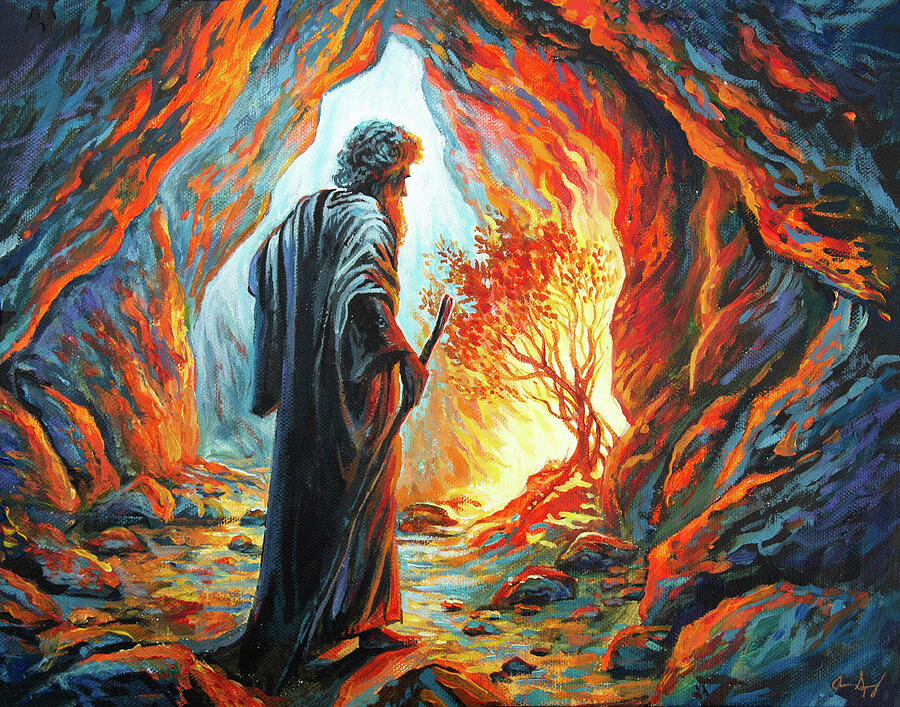
Painting - Moses and the Burning Bush by Aaron Spong


In the Name of the Father and of the + Son and of the Holy Spirit. Amen.


Do you think that I have come to give peace on earth? No, I tell you, but rather division. 


I’m guessing none of us have this section of Scripture for our confirmation verse or scrolled in beautiful calligraphy over our fire place. Maybe you even winced a little while saying, “This is the Gospel of the Lord.”


Jesus’ words in Luke 12 are challenging to hear. Hard to understand. Why is the Prince of Peace speaking about fire, baptism, peace, and division? 


Knowing what’s happening in Luke 12 and what Jesus says will give us a better grasp of this hard saying of Jesus, and help us better understand Jesus’ pyrotechnic preaching


Throughout Luke 12, Jesus addresses several groups of people: His disciples. The crowds. And the Pharisees. Jesus prepares his disciples for future persecutions; he warns the disciples and the crowds against the hypocrisy of the Pharisees; and he lovingly admonishes them not to trust in possessions. Fear not. Jesus’ death and resurrection is greater than all that life throws at you. God has you covered. He is faithful. He will preserve, protect, and deliver you. 


And then comes today’s reading: I came to cast fire on the earth, and would that it were already kindled! I have a baptism to be baptized with, and how great is my distress until it is accomplished!  


Even though his language sounds jarring, Jesus’ has been leading us and his disciples to this very point. Fire. Baptism. Peace. Division. These words encompass everything Jesus’ ministry is about. 


Fire, as we know well during wildfire season, is both destructive and purifying. Scripture uses fire both ways: as a sign of God’s judgment and wrath against sin. Fire is also refining, purifying, holy-making like when Jesus pours out the Holy Spirit and fire on Pentecost, the fiery wind of the Spirit. Gospel fire. Like the pillar of fire that led Israel through the Sea or the fire of the burning bush that did not burn up, the fire Jesus casts upon the earth is a refining, purifying, illuminating fire.


For Jesus is the one upon whom the fire of God’s wrath for sin has fallen. On the cross, God’s wrath is kindled, but not against us. On Jesus. We’re like Shadrach, Meshach, and Abednego, as Jesus is crucified in the fiery furnace of God’s wrath to save us. 


For fire to be kindled, there must be sacrifice, a whole burnt offering, a sinless Victim for the sinful many. For this peace that passes our understanding to come to us, there must be a death, and not just any death, but the death of God in the Flesh. He alone can kindle this fire. No amount of rubbing the sticks of our good works together can accomplish this, no matter how many merit badges we accumulate to our credit. 


Only Jesus can bring Pentecost fire to the earth, but first, He must die and rise. There is no other way than the way of the cross. And in the words of today’s Gospel, He is driven and compelled to the cross. 


And would that it were already kindled, Jesus says. Great is my distress until it is accomplished. Finished. Completed. 


Jesus is pointing us ahead to his crucifixion. His ministry begins and ends with Baptism. First his watery baptism in the Jordan. Then his bloody/fiery baptism on the cross as he atones for the sin of the world. The water of the Jordan that flowed over Jesus’ head gives way to the water and blood that flows out of Jesus’ side. From the cross. To the font. To the chalice. For you. 


This is what brings peace. In the darkness of Good Friday, the fire of God’s love burns brightest. The burning passion of God to save sinful humanity and a fallen creation. There, in Jesus’ death, is a peace that the world cannot give. A peace the world does not know. A peace the world hates. It’s the peace of sins washed away by the blood of the Lamb, the peace of good news and rescue…that for you, there is no condemnation for you in Christ Jesus.


This, then, is the irony and paradox of the Christian life. Receiving His peace. Baptized into Jesus’ death and resurrection. Purified and cleansed by his sacrifice on the cross….means that more often than not, we find ourselves at odds with the world. 


Do you think that I have come to give peace on earth? No, I tell you, but rather division. 


For many of us, Jesus’ words hit home. We live in a divided world. Simply confessing the Christian faith, and living in Christ, we’re divided from those who don’t. Some leave the church or reject our Lord. And then there’s our sins of thought, word, and deed that cause division in our families, marriages, friendships, and everything. This is why we call the church the family of God. Brothers and sisters in Christ. Bound together by the cross; the font; and the altar –the communion of saints.


Jesus was no stranger to division. That’s exactly what happened to him on the cross. Jesus…Forsaken for you. Judged for you. Crucified for you. Jesus was divided from the Father as he bore all our sins of division, so that in his death and resurrection you and I would never be divided from him. 


Therefore let us run with endurance the race that is set before us, looking to Jesus, the founder and perfecter of our faith, who for the joy that was set before him endured the cross, despising the shame, and is seated at the right hand of the throne of God. Consider him who endured from sinners such hostility against himself, so that you may not grow weary or fainthearted.


In the Name of the Father and of the + Son and of the Holy Spirit. Amen. 

Monday, August 4, 2025

Sermon for Pentecost 8: "Parable of the Rich Fool"


+ 8th Sunday after Pentecost – August 3rd, 2025 + 

Series C: Ecclesiastes 1:2 – 2:26; Colossians 3:1-11; Luke 12:13-21

Beautiful Savior Lutheran Church

Milton, WA


A Chorus of Voices: The Reception History of the Parables: Rembrandt and  the Parable of the Rich Fool of Luke 12:16-20 (Part 1)


In the Name of the Father and of the + Son and of the Holy Spirit. Amen.


C.S. Lewis opens his famous Narnia book, The Voyage of the Dawn Treader by telling us…“There once was a boy named Eustace Scrubb and he almost deserved the name.” As the story moves along, you see why Lewis said this about Eustace. He’s arrogant. Selfish. Self-righteous. As the story progresses, Eustace wanders off alone and finds himself (though unbeknownst to him) in a dragon’s lair surrounded by the dragon’s hoard. He’s giddy and greedy. A deadly synthesis. 


When morning comes he wakes up only to discover that he has become the dragon. Eustace has fallen ill with what the old tales call dragon-sickness. The love of gold…of possessions…and stuff.


Dragon-sickness isn’t just in fairy tales though. You’ll find it in the true story of the Scriptures too. An unknown man in the crowd comes up to Jesus and says, “Teacher, tell my brother to divide the inheritance with me.”


It doesn’t take a family therapist to realize this isn’t an idyllic episode of “Leave it to Beaver.” The father has died, leaving no oral or written will. The brothers are bickering over who gets dear-old-dad’s estate. It’s divisive and ugly. And Jesus knows it, and wants no part in it. “Man, who made me a judge or arbitrator over you?”


The problem isn’t that this man seeks out Jesus, but that he comes to Jesus searching for the kind of justice that Jesus did not come to bring. Justice comes when Jesus justifies sinners by his death for you. Jesus didn’t take on human flesh to take on inheritance disputes, but to take on your sin and be your Savior. This fellow wants Jesus to divide the inheritance between him and his brother, while Jesus comes to reconcile sinners, rescue you from idolatry, and rob the grave of swallowing you and I in our desires. 


Jesus gives the antidote to dragon-sickness. His prescription comes to you in a story. He starts this way. “Take care, and be on your guard against all covetousness, for one's life does not consist in the abundance of his possessions.” 


One’s life – body and soul, Jesus says, does not depend upon, consist of, or rest upon gold, galleons, or loads of stuff…but on grace on gift from God’s hands to your life. This man in the parable falls into the dragon’s lair, thinking everything he has – possessions, wealth, land, abundant crops, barns bursting at the rafters with produce –was all his due…what he deserved, when in fact it’s all gift. 


Same is true for you. Everything you have, is as an old radio host once said, talent on loan from God. All you and I have from the soles of your shoes and sandals to the top of your head, everything below and above and around you, everything in your home, closet, driveway, garage, and bank accounts. It’s all gift from your good and gracious Heavenly Father. 


This story is called the parable of the rich fool not because this man is rich…anyone can be a fool no matter what’s in your wallet. He’s a fool because he’s self-righteousness. He trusts in his riches, and not the righteousness that comes as free gift in God’s steadfast love. He is a fool because he has the wrong god.


‘What shall I do, for I have nowhere to store my crops?’ 18 And he said, ‘I will do this: I will tear down my barns and build larger ones, and there I will store all my grain and my goods. 19 And I will say to my soul, “Soul, you have ample goods laid up for many years; relax, eat, drink, be merry.”’


This is what sin and greed does…it’s myopic. It curves you and I in on ourselves…just like this fellow. Everything is               “I”       “I”            “I“       “My”   “My”   “My”. It’s exhausting.


Reminds something the great hymn-writer, Johnny Cash, once sang: 

How many times have…You heard someone say…If I had his money…I could do things my way

But little they know…That it's so hard to find…One rich man in ten…With a satisfied mind


The rich fool is like Eustace Scrubb. He’s down with the dragon-sickness. And if all that’s not dark enough, this rich fool is utterly alone. He has no family, no friends, no community to share his stuff with…so he talks to himself. This is what the devil and your sinful flesh won’t point out on the warning labels of your sinful desires: idolatry is terribly isolating and sin leaves you utterly alone. 


 So is the one who lays up treasure for himself and is not rich toward God.”


This part of the story is terrifying. Jesus’ story reveals that there’s a rich fool within you and in me, that is always desiring what is best for I, I I, and what’s mine , mine, mine. It’s the ugly truth, but you and I are idol-hoarders. You and I are like this rich fool, possessed by our possessions, rather than holding them in the open, dead-hand of faith. We’re deadly ill with dragon-sickness.


For Eustace and for the rich fool, and for you and I, there is only one cure. It’s not selling everything you have. It’s not even using the good things you have with enjoyment and thankfulness and for your neighbor – that’s the fruit and it’s good. 


But the cure is death. For Eustace, in that story, Aslan the Lion came along and tore his scaly, dragon, hide right off of him, dunked him in a pool, washed him, clothed him, and he was a new boy. Dead and alive again.


So it is for you. Your life does not consist of your possessions, but in Christ who possesses you by his passion to save. Jesus has un-dragoned you in the pool of water we call a baptismal font. Jesus, the Lion of Judah dunks you in the water, drowns your sin -along with all its desires, greed, and idols – and washes you clean, robes you in his holiness and righteousness, calls you his own. He treasures and cherishes you, lavishes his grace and goodness and gifts of body and soul upon you. Not just once. Not just a little bit. But daily. Abundantly. More than you ask for. More than you deserve. Grace upon grace upon grace. 


You are free. Free to thank God for whatever he’s given you, be it little or much. Free to be content in our Lord’s gifts of daily bread. Free to enjoy God’s gifts of daily bread. Free to hold them in the loose, dead hand of faith. Free to use God’s gifts in love and service of your neighbor. 


You were dead. But now you are alive. You were dragon-sick, but now you are holy in Jesus. Your life isn’t found in your insatiable desires, but in the incredible, all-sufficient grace of Jesus crucified and risen for you. This is what it means to be rich towards God. To know that you are his treasure. That all you have is a gift. And that today he comes bearing even more gifts. Holy treasures hidden in humble things: water that drowns your sins. words that raise you from the dead. Body and blood in bread and wine that strengthen you against the dragon’s breath by a promise: you are forgiven all your sins.


In the Name of the Father and of the + Son and of the Holy Spirit. Amen.